
The Vertical Archipelago: Finding Soul Above the Arctic Circle
In Norway's Lofoten Islands, a dramatic spine of granite rises from the sea, offering a profound encounter with the raw elements. Between vertiginous hikes, silent paddles through ancient fjords, and the surreal glow of the midnight sun, one finds a landscape that doesn't just challenge the body, but reshapes the soul.
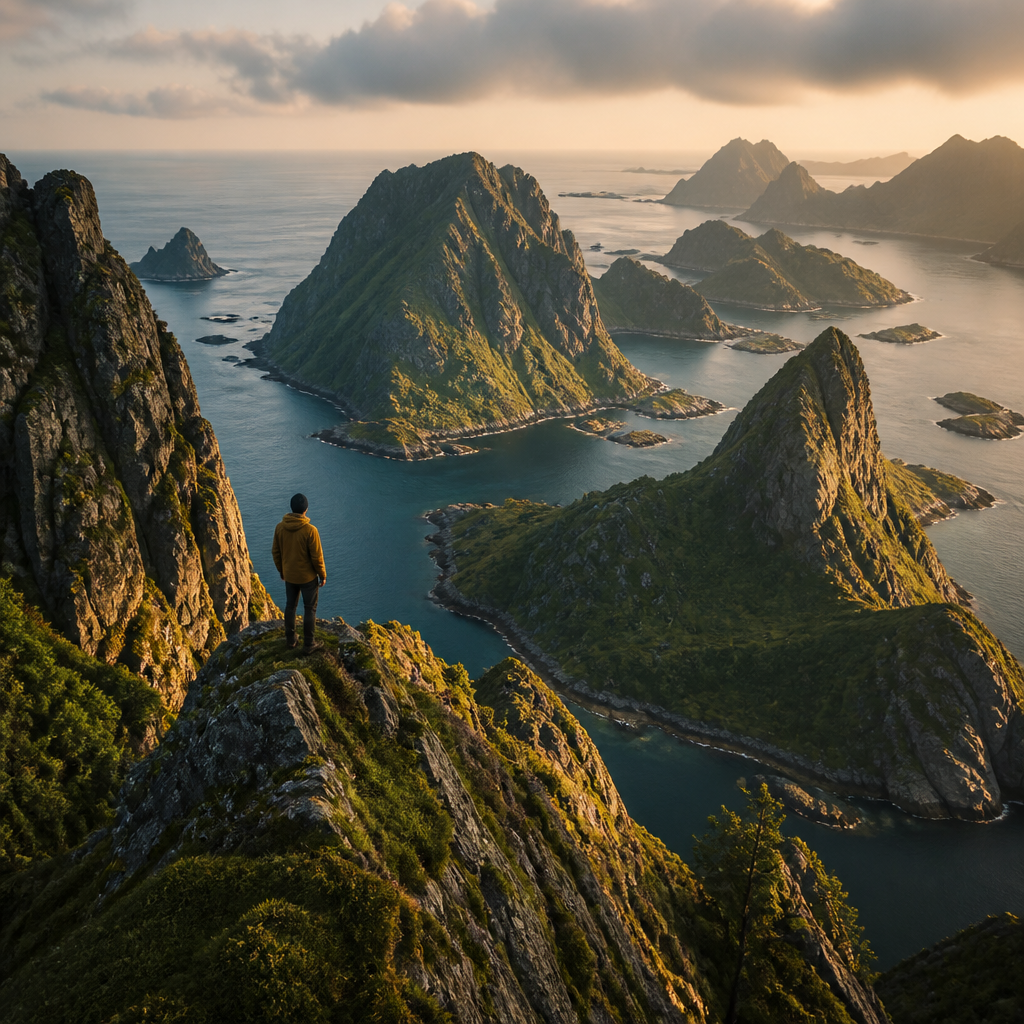
There is a moment, on the approach to the Lofoten Islands, when the world tilts on its axis. From the ferry deck or a plane window, they first appear as a mirage—a jagged wall of granite clawing at the sky, a dragon’s spine rising impossibly from the steel-blue Norwegian Sea. Located entirely above the Arctic Circle, this is a land of profound and beautiful contradictions. It is a place where the serene beauty of a postcard scene—a red fishing cabin reflected in mirror-calm water—is perpetually underscored by the raw, untamable power of the elements that carved it.
To visit Lofoten is not simply to see a landscape, but to feel it in your bones. It’s the sting of salt spray on your face, the burn in your thighs on a near-vertical trail, and the disorienting, ethereal glow of a sun that refuses to set. It is an archipelago that demands your presence, rewarding the adventurous with a quiet, indelible mark on the soul.
Where Granite Meets the Sky
The mountains are Lofoten’s irrefutable truth. They are not the rolling, ancient hills of other lands; they are sharp, aggressive, and geologically young, their peaks like teeth biting at the clouds. To truly understand the islands, you must ascend. And there is no ascent more iconic, more breathless in every sense of the word, than Reinebringen.
It’s less a hike and more a pilgrimage. For years, the route was a treacherous, muddy scramble. Today, a remarkable stone staircase, built by Nepalese Sherpas, makes the summit attainable, though no less demanding. The climb is a 448-meter meditation in repetition. Step, breathe. Step, breathe. The world shrinks to the stone beneath your boots and the rhythm of your own heart. Below, the village of Reine, a scattering of colorful toys, gets smaller and smaller. The fjord, a deep slash of turquoise, widens into a panoramic tapestry.
Reaching the summit ridge is a revelation. The wind hits you first, a clean, wild blast from the open sea. Then, the view unfolds—a staggering 360-degree vista of fjords, bridges, and neighboring islands, all cradled by a coliseum of granite spires. You’re standing on a knife’s edge, with the world falling away on all sides. It is a humbling, dizzying perspective that rearranges your sense of scale. The concerns of daily life feel impossibly distant when measured against the patient, geological time written in the rock around you.
The Salt-Stained Soul
If the mountains are Lofoten’s bones, the sea is its lifeblood. For over a thousand years, this has been the epicenter of the world’s largest cod fishery. Each winter, the skrei—a migratory Arctic cod—return to these waters to spawn, a bounty that has sustained generations and shaped the very architecture of the islands.
Evidence is everywhere. You see it in the wooden racks, or hjell, that blanket the coastline, covered with drying stockfish whose pungent, briny scent is the signature perfume of the islands. And you see it in the rorbuer, the iconic red fishermen’s cabins built on stilts over the water. Many have been beautifully restored into cozy accommodations, offering a direct connection to this history. To sleep in a rorbu is to feel the tide rise and fall beneath you, to hear the cries of gulls and the gentle creak of old wood, a lullaby millions of fishermen have known before you.
To truly commune with the water, however, one must get on its level. Sea kayaking here is an exercise in sublime silence. Paddling through a narrow fjord, the only sounds are the dip of your blade into the clear, cold water and the distant call of an oystercatcher. The towering mountain faces, which seemed so imposing from their summits, now feel protective, their sheer cliffs plunging directly into the sea beside you. Gliding past a colony of puffins or watching a white-tailed sea eagle circle lazily overhead, you inhabit a different Lofoten—a quieter, more intimate version, seen from the perspective of the creatures who have always called it home.
In the Glow of Arctic Light
Life in the archipelago is dictated by the extreme cycles of Arctic light. To experience Lofoten in summer is to live within a dream of endless day. The Midnight Sun, from late May to mid-July, erases the border between night and day. The sun dips towards the horizon, bathing the landscape in a warm, golden alchemy for hours on end, before climbing back into the sky. It’s a phenomenon that infuses you with a strange, boundless energy. A hike that begins at 10 p.m. feels perfectly normal. The world is soft, saturated, and eternally caught in the magic hour.
Winter offers the dramatic counterpoint: the Polar Night. From early December to early January, the sun does not rise above the horizon. But this is not a time of absolute darkness. Instead, the days are filled with a soft, pearlescent twilight, where the sky glows with deep blues, purples, and magentas. This ethereal gloom sets the stage for the true queen of the Arctic winter: the Aurora Borealis. On a clear, cold night, to witness the Northern Lights dance across the sky is to see magic made real. A faint green smudge on the horizon can erupt into a celestial river of light, a silent, shimmering curtain that ripples and flows with an intelligence all its own. It is a spectacle so profound, so otherworldly, that it feels less like something you see and more like something you experience with your entire being.
Ultimately, Lofoten is more than a destination; it's an elemental encounter. It’s a place that strips away the non-essential, leaving you with the wind, the rock, the water, and the sky. You come here for the adventure, for the photograph, for the challenge. You leave with the quiet resonance of a landscape that is both ferociously wild and deeply peaceful, and the humbling knowledge that you have stood, for a moment, on the beautiful, unforgiving edge of the world.
<!-- seo-rank-booster:v1 -->Frequently Asked Questions
What is the best time to visit the Lofoten Islands?
The best time to visit depends on your goals. For hiking under the midnight sun and experiencing endless daylight, visit between late May and mid-July. For a chance to see the Northern Lights and experience a dramatic, snow-dusted landscape, plan your trip between September and March.
Is hiking in the Lofoten Islands difficult?
Many Lofoten hikes are challenging, characterized by steep, vertiginous ascents. Trails like Reinebringen are essentially a strenuous stair-climb, but the effort is rewarded with some of the most iconic views in Norway. Always check trail conditions, as weather can change rapidly, and choose hikes that match your fitness level.
What are the Lofoten Islands famous for?
The Lofoten Islands are famous for their dramatic, sharp mountain peaks rising directly from the sea, traditional red fishing cabins (rorbuer), and their historical connection to the world's largest cod fishery. They are also a world-renowned destination for experiencing natural phenomena like the midnight sun in summer and the aurora borealis in winter.
Can you see the Northern Lights in Lofoten?
Yes, absolutely. Being located well above the Arctic Circle, the Lofoten Islands are a prime location for viewing the Northern Lights (aurora borealis). The best viewing season is during the darker months, typically from early September to late March, when the nights are long and clear skies are more common.
Related on Bucketlist Field Guide
- The Highline Trail — For another iconic hike with dramatic, knife-edge exposure and staggering mountain views.
- Skyline Trail Loop — If you're seeking a challenging loop that delivers constant, panoramic vistas similar to those found atop Lofoten's peaks.
- Presidential Traverse — For an epic adventure that tests your endurance against raw, powerful mountain elements, much like the Lofoten landscape.