
The Serpent's Spine: On the Edge of Vietnam's Ha Giang Loop
Four days, 350 kilometers, and one temperamental semi-automatic motorbike. A journey on Northern Vietnam's legendary Ha Giang Loop is more than a road trip—it's a pilgrimage into a land of limestone giants, resilient cultures, and the echoing silence at the edge of the world.
The Call of the North
The air in Hanoi is thick enough to taste—a humid cocktail of diesel fumes, sizzling street food, and the ceaseless hum of a million motorbikes. It’s a city that moves with the frenetic, improvisational energy of a jazz solo. But somewhere to the north, beyond the concrete and the chaos, a different kind of music plays. It’s a slower, deeper melody, carried on the wind that sweeps across a forgotten frontier. This is the call of Hà Giang, a name whispered among seasoned travelers with a mix of reverence and grit. It’s a province scalloped into the border with China, a place of mythic landscapes and a road that has become a legend: the Ha Giang Loop.
Leaving the capital is a baptism by traffic. You push north, first by bus, then by the saddle of a rented 110cc Honda Wave—the trusty, sputtering chariot of Southeast Asia. Strapping a dusty backpack to the seat and a helmet to your head feels like a rite of passage. The first twist of the throttle is a leap of faith. The urban sprawl slowly dissolves, replaced by rice paddies of an impossible green, and then, the first foothills begin to rise. The road narrows, the air cools, and the world begins to feel quiet, raw, and immeasurably vast. The pilgrimage has begun.
The Road Unfurled
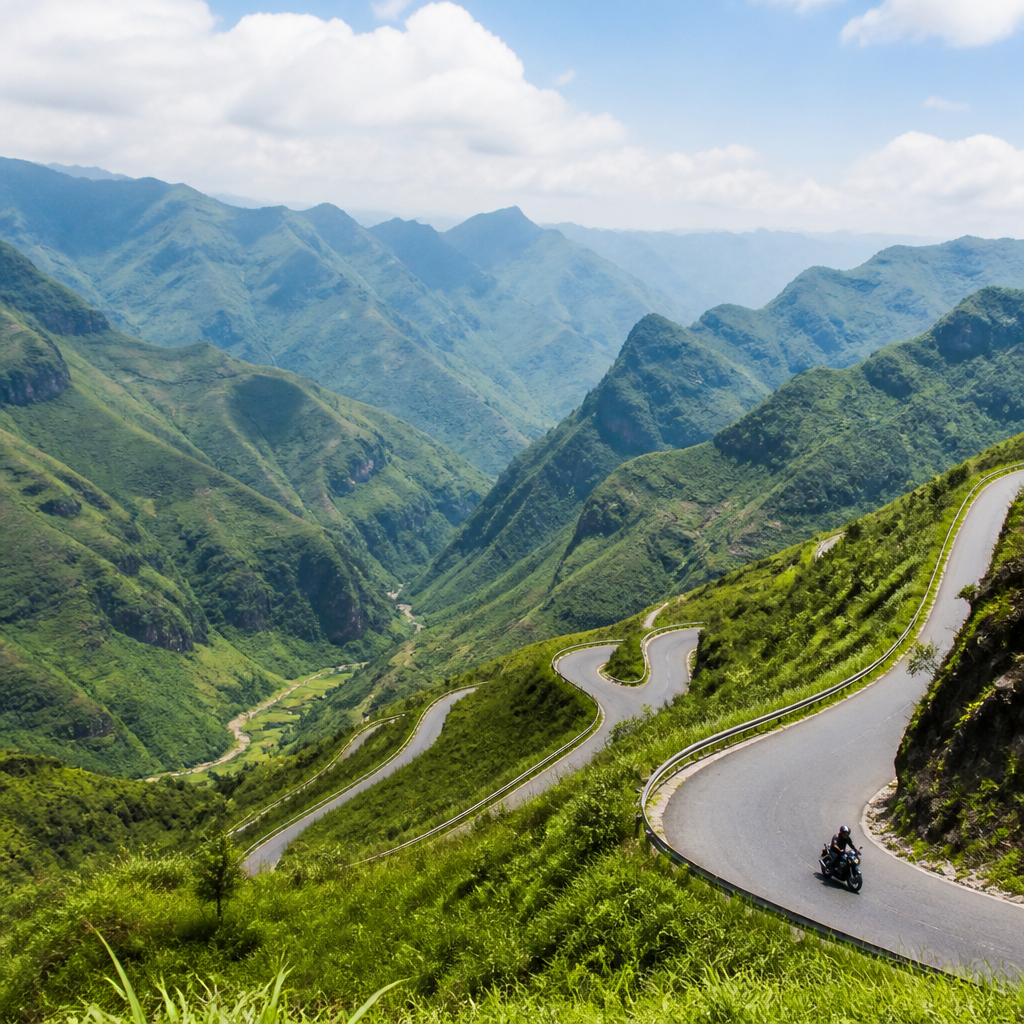
The Loop is not a road you simply drive; it’s a living thing you must learn to read. For 350 kilometers, it coils and climbs, a ribbon of asphalt draped over what feels like the very spine of the earth. The first day is an education in physics and nerve. You learn the delicate dance of upshifting on a climb, the art of engine-braking on a steep descent, and the unspoken language of a horn toot to announce your presence around a blind curve. Water buffalo, laden with a placid indifference, become moving chicanes. Schoolchildren, walking home in their uniforms, offer waves and brilliant, unabashed smiles.
This is the road to Quan Ba, marked by the iconic Heaven’s Gate pass. As you ascend, the world opens up below. The valley floor is a patchwork of fields and villages, bisected by the languid blue of the Lô River. From this vantage, you can see the road you’ve traveled and the road yet to come, a dizzying serpent of switchbacks. The air here is different—thin and clean, carrying the scent of damp earth and woodsmoke. It feels less like a viewpoint and more like a threshold, a passage into another realm. You are no longer just observing the landscape; you are a tiny, moving part of it.
Among Giants
The heart of the Ha Giang Loop is the Dong Van Karst Plateau, a UNESCO Global Geopark. This is where the landscape sheds all restraint and indulges in geological fantasy. For millions of years, the earth has buckled and eroded into a breathtaking panorama of limestone karsts. These are not mountains in the traditional sense; they are jagged, black-toothed towers that erupt from the ground, looking like the fossilized bones of ancient gods. They dwarf everything—the road, the villages, you.
To ride through this place is to feel profoundly small. The infamous Tham Ma Pass, a series of nine tight hairpins, climbs up the side of a cliff, each turn revealing a more dramatic vista than the last. You navigate it with a mix of concentration and awe. Nestled in these impossible valleys are the homes of Vietnam’s ethnic minorities—the Hmong, the Tay, the Dao. Their villages cling to the mountainsides, and their fields are carved into terraces that defy gravity. You see women in intricately embroidered indigo skirts, carrying bundles of firewood or baskets of corn on their backs, their strength and resilience etched into the landscape itself. This is not a wilderness devoid of humanity, but a place where humanity has learned to live in a delicate, hard-won harmony with an epic environment.
The Northernmost Point
The pilgrimage has its own Mecca: the Lũng Cú Flag Tower. A side trip off the main loop takes you up a final, winding ascent to a monumental tower marking Vietnam’s northernmost point. Climbing the spiral stairs inside the tower, you emerge onto a platform where a vast Vietnamese flag, an ocean of red fabric, cracks and snaps in the wind. The view is staggering. On one side lies the labyrinthine geology of Hà Giang; on the other, the hazy, rolling hills of China.
There is a profound symbolism here. To stand at this border is to stand at an edge—not just of a country, but of an experience. It’s a geographical full stop, a moment for quiet reflection on the miles traveled. You are as far as you can go. Looking out, you don’t feel a sense of division, but one of immense, humbling scale. The lines on the map feel arbitrary against the ancient, indifferent grandeur of the mountains.
The Soul of the Road
But the Loop’s magic isn’t just in its towering peaks or precipitous drops. It’s found in the moments between. It’s in the shared camaraderie with fellow riders you meet along the way—a nod of solidarity, a shared story over a bowl of phở in a roadside shack. It’s in the unexpected kindness of a homestay host in Dong Van, who shares her rice wine and a laugh that needs no translation.
It’s also in the challenges. A sudden afternoon downpour that soaks you to the bone and turns the road slick. A sputtering engine that requires a moment of roadside mechanical diplomacy. These aren’t setbacks; they are the texture of true adventure. The constant focus required—the hum of the engine, the feel of the road through the handlebars, the scanning for potholes and livestock—becomes a form of meditation. The ceaseless chatter of the modern mind goes quiet, replaced by the singular, immediate task of moving forward. You are not thinking; you are simply being.
The Descent and the Echo
The final day of the loop, a stunning ride along a river canyon from Meo Vac to Ha Giang city, is a slow descent back to reality. The karsts soften, the valleys widen, and the traffic gradually rebuilds. There is a palpable sense of accomplishment, but it's tinged with the melancholy of an ending journey. Rolling back into the city where you began, the bike feels less like a machine and more like a trusted partner. The engine cools with a final series of ticks and pings.
The silence that follows is deafening. But the journey isn’t over. It has imprinted itself upon you. For weeks after, you will feel the phantom lean of the bike in a turn, hear the echo of the wind in your ears. The Ha Giang Loop is more than a road on a map. It’s a reminder that there are still places in this world that demand your full attention, that reward you with a sense of perspective that can only be earned with grit, gasoline, and an open heart. It’s a journey to the edge of a country, but more importantly, to the untamed frontiers within yourself.
<!-- seo-rank-booster:v1 -->Frequently Asked Questions
How many days do you need for the Ha Giang Loop?
The typical Ha Giang Loop itinerary takes 3 to 4 days to complete the roughly 350-kilometer journey without rushing. This allows enough time to navigate the winding mountain passes, stop at key viewpoints like Heaven's Gate and the Ma Pi Leng Pass, and experience the local culture in towns like Dong Van and Meo Vac.
Is the Ha Giang Loop dangerous for beginners?
The Ha Giang Loop is a challenging ride with steep ascents, sharp hairpin turns, and unpredictable road conditions. While experienced riders will be more comfortable, many beginners complete it successfully. It is crucial to ride cautiously, use your horn on blind corners, understand how to use a semi-automatic motorbike, and never ride after dark. Safety should always be your top priority.
What is the best time of year to ride the Ha Giang Loop?
The best time to ride the Ha Giang Loop is during the dry season, which runs from October to April. During these months, the weather is cooler and there is less rain, making for safer road conditions and clearer views of the stunning karst landscapes. The spring months of March and April often feature blooming flowers, while October and November showcase the golden rice terraces after the harvest.
Can you do the Ha Giang Loop without a guide?
Yes, it is very common for travelers to ride the Ha Giang Loop independently, which offers maximum freedom and adventure. However, for those who are not confident in their riding skills or prefer not to handle the logistics, joining a guided tour or hiring an "easy rider" (a local who drives the motorbike for you) are excellent alternatives.
What bike do you need for the Ha Giang Loop?
A semi-automatic scooter, like a 110cc or 125cc Honda Wave, is the most common and recommended choice for the loop. These bikes are lightweight, easy to handle, and powerful enough for the steep mountain roads. They are also extremely common in the region, making repairs and finding parts simple if you run into any mechanical issues.
Related on Bucketlist Field Guide
- Presidential Traverse — For another multi-day journey across a legendary and challenging mountain spine.
- Hoh River Trail to Blue Glacier — Embark on a long pilgrimage into a remote and wild landscape defined by natural giants.
- The Highline Trail — Experience a world-class route that travels along the edge of dramatic, awe-inspiring mountain vistas.
- ZOLEO Satellite Communicator — For any adventure that takes you to the edge of the world, reliable communication is essential.