
The Great Reflection: A Journey Across Bolivia's Altiplano
In the high-altitude desert of Bolivia lies the Salar de Uyuni, the world's largest salt flat. More than a destination, it is a canvas of perception—a place where the sky merges with the earth, and the silence speaks volumes, forcing a profound recalibration of scale and self.
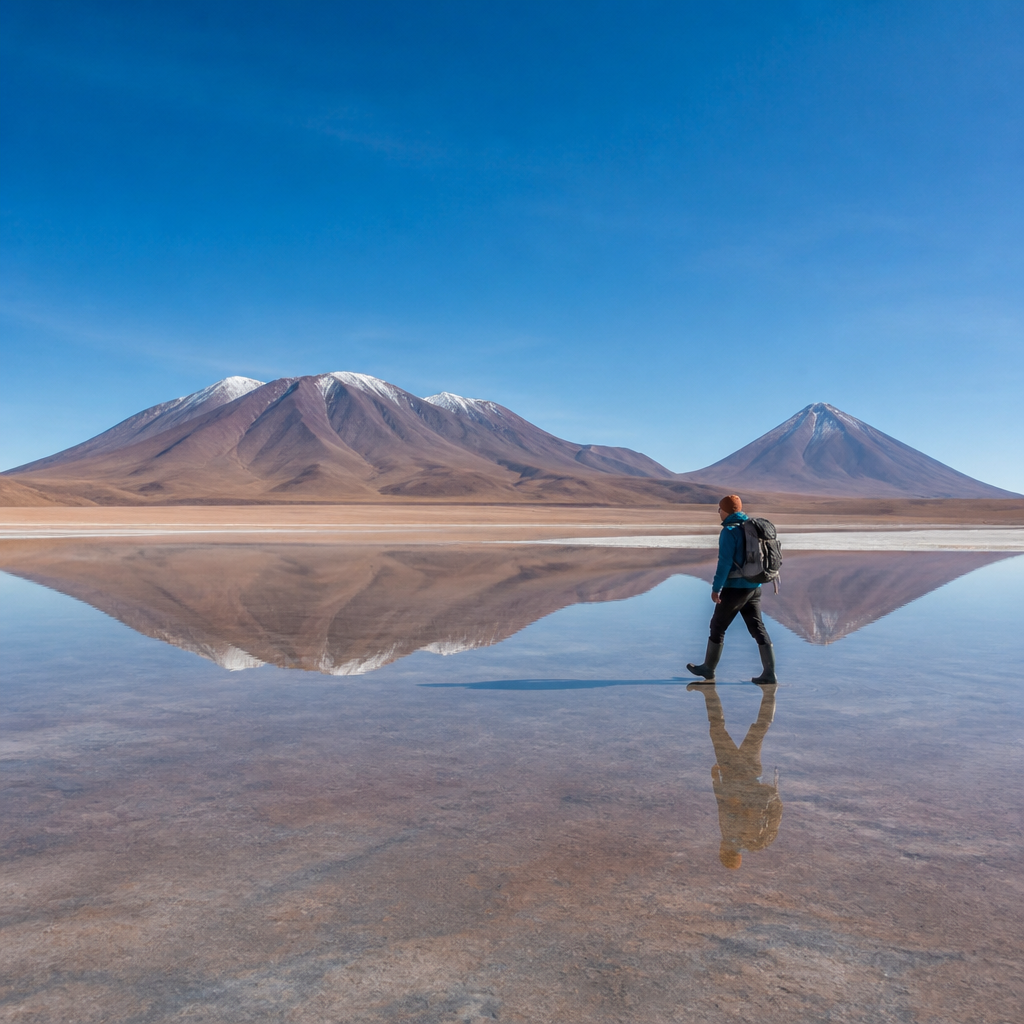
The transition is subtle, then absolute. One moment, the Land Cruiser is rattling over the dusty, corrugated earth of the Bolivian Altiplano. The next, all dust is gone. The sound changes from a gritty complaint to a crisp, satisfying crunch, as if we’re driving over a crust of crème brûlée. Outside, the world has bleached itself to an impossible white. Under a sapphire sky, a hexagonal pattern of crystallized salt stretches to a horizon so flat and distant it seems less a line and more a theoretical concept. This is the Salar de Uyuni. It is not so much a place you arrive at as a state you enter.
At 12,000 feet, the air is thin and carries a crystalline clarity, making the light feel more direct, more elemental. You are standing on a dried prehistoric lakebed, a salt pan so vast it can be seen from space. And for a moment, your senses fail you. There are no trees, no buildings, no points of reference to give you your bearings. The scale is so immense that perspective warps. Distant trucks appear to float in mid-air, and a friend walking only a hundred yards away can shrink to a featureless speck. It’s a landscape that humbles you immediately, quietly dismantling your ego by illustrating its utter irrelevance.
The Crystalline Sea
To cross the Salar is an exercise in minimalist travel. For hours, the only change in scenery is the subtle shift of the sun and the long, sharp shadow of the vehicle racing beside you. The world is reduced to three things: the blinding salt below, the boundless sky above, and the vibrating machine carrying you between them. The ground itself is a mosaic of puffy, interlocking polygons of salt, a natural tiling that covers nearly 4,000 square miles.
Then, like a mirage that refuses to dissolve, an island appears. This is Isla Incahuasi, a rocky outcrop of fossilized coral and volcanic rock that was once the peak of a volcano submerged in the ancient lake. Today, it stands as a startling bastion of life in the sterile expanse, covered in giant, centuries-old cardon cacti that rise toward the sky like silent, patient sentinels. To climb the path to its summit is to see the Salar in its full, breathtaking context. From this vantage point, you are a castaway on a rocky isle in a sea of solid salt. The silence, broken only by the wind whistling past the spines of the cacti, is profound. It’s the kind of quiet that has weight, pressing in on you, demanding your attention.
If you time your visit for the rainy season, from December to April, you witness the Salar’s most famous transfiguration. A thin layer of water floods the pan, transforming it into the world's largest mirror. The horizon vanishes completely. The sky is perfectly reflected on the ground, and to stand upon it is to feel as if you are floating in an endless, cloud-filled void. It is disorienting, surreal, and deeply beautiful—a fleeting baptism in the infinite.
Where Industry Meets Eternity
The Salar is not entirely divorced from the human world. Its edges are frayed with signs of life and history. Just outside the town of Uyuni, which serves as the primary staging post for expeditions, lies the Cementerio de Trenes, the Train Cemetery. Here, the great steam locomotives of the 19th and 20th centuries, which once hauled minerals from the Andes to Pacific ports, now sit rusting into sculptures of beautiful decay. Children play hide-and-seek among their hollowed-out shells, and travelers climb their skeletal frames, posing against a backdrop of oxidizing grandeur. The trains are a poignant monument to industrial ambition and the relentless power of time and neglect.
In the village of Colchani, on the Salar's eastern shore, we see the human side of the salt itself. Here, local miners work the pan in the old ways. They shovel the damp salt into conical piles to drain, then load it onto trucks to be processed. Their faces are weathered by the sun and the caustic salt, their hands tough and calloused. It's a hard existence, wresting a living from this unforgiving landscape. To see them work is to be reminded that this sublime, otherworldly place is also a resource, a workplace, a source of survival.
The Painter's Desert
Beyond the white expanse of the Salar, the journey south unfolds into the Eduardo Avaroa Andean Fauna National Reserve, a landscape that defies belief with its riot of color. The Altiplano erupts into a surrealist dreamscape. We drive through the Siloli Desert, where the wind has carved stones into impossible shapes, most famously the Árbol de Piedra, or Stone Tree.
The ground shifts from ochre to rust to pale green. We reach Laguna Colorada, the Red Lagoon, whose waters are stained a deep terracotta by sediments and algae. And wading through this crimson water are hundreds, sometimes thousands, of James's flamingos, their pink plumage a shocking contrast against the red water and white, borax-crusted islands. It’s a scene of such bizarre and vibrant beauty it feels like a hallucination. Further on, at the foot of the Licancabur volcano, lies Laguna Verde, whose waters shift from turquoise to a deep emerald depending on the disturbance of the wind on its mineral-rich sediments. Everywhere, herds of wild vicuñas, their wool the finest in the world, graze on the sparse, tough grasses, their elegant forms moving gracefully across the high plains.
Recalibrating the Soul
What do you take away from a place that seems to exist on the edge of reality? It’s more than just photographs of perspective tricks or memories of otherworldly colors. A journey across the Salar de Uyuni and the surrounding Altiplano is a journey inward. In its vastness, you are forced to confront your own scale. In its silence, you are forced to listen to your own thoughts, stripped of the constant static of daily life.
This is a landscape that teaches you about endurance—the patience of a cactus growing for centuries, the slow decay of a mighty engine, the resilience of life in a pool of red water. It’s a recalibration of the soul. Lying on your back on the salt at night, under a dome of stars so brilliant they seem within reach, you feel a connection to something ancient and immense. The cold air, the endless salt, the silent galaxies—they don’t make you feel small, but rather part of something immeasurably large. You leave the white horizon not with a collection of souvenirs, but with a profound and lasting sense of stillness.
<!-- seo-rank-booster:v1 -->Frequently Asked Questions
What is the best time to visit Salar de Uyuni for the mirror effect?
The best time to witness the famous mirror effect at Salar de Uyuni is during the rainy season, which typically runs from December to April. A thin layer of water covers the salt pan, creating a stunning, expansive reflection of the sky. The dry season, from May to November, offers a different beauty with its vast, white, hexagonal landscape.
What is Salar de Uyuni?
Salar de Uyuni is the world's largest salt flat, located in the high-altitude Altiplano region of southwestern Bolivia. It is the remnant of a prehistoric lake that dried up, leaving behind a desert-like expanse of salt crust covering nearly 4,000 square miles. The sheer scale and flatness of the terrain create unique visual effects, making it a major travel destination.
What is there to see at Salar de Uyuni besides the salt?
Key attractions include Isla Incahuasi, a rocky island covered in giant cacti that offers panoramic views of the salt flat. Near the town of Uyuni, you can also visit the Cementerio de Trenes (Train Cemetery), where historic steam locomotives are left to rust in the desert. These sites offer fascinating contrasts to the minimalist landscape of the Salar.
How do travelers visit Salar de Uyuni?
Most travelers arrange multi-day 4x4 tours that depart from the town of Uyuni, which serves as the primary gateway to the salt flats. These guided expeditions are the most common and safest way to navigate the immense and featureless terrain. Tours typically include a driver/guide, meals, and accommodation in basic salt hotels or local villages.
Related on Bucketlist Field Guide
- The Iceline Trail — Explore another otherworldly landscape of vast glaciers and high-alpine views in the Canadian Rockies.
- Hoh River Trail to Blue Glacier — Embark on a long journey through a temperate rainforest to witness the power of a singular, elemental destination.
- Skyline Trail Loop — Experience breathtaking, high-altitude panoramas that evoke the endless horizons of the Salar.
- ZOLEO Satellite Communicator — Stay safe and connected while exploring remote, off-grid locations like the Bolivian Altiplano.