
The Wind Horse and the Eagle's Eye: A Journey to Mongolia's Altai Frontier
In the far western reaches of Mongolia, where the Altai Mountains scrape the sky, a journey is not measured in miles but in moments. It’s a pilgrimage into a land of raw beauty and living history, alongside the last of the nomadic Kazakh eagle hunters.
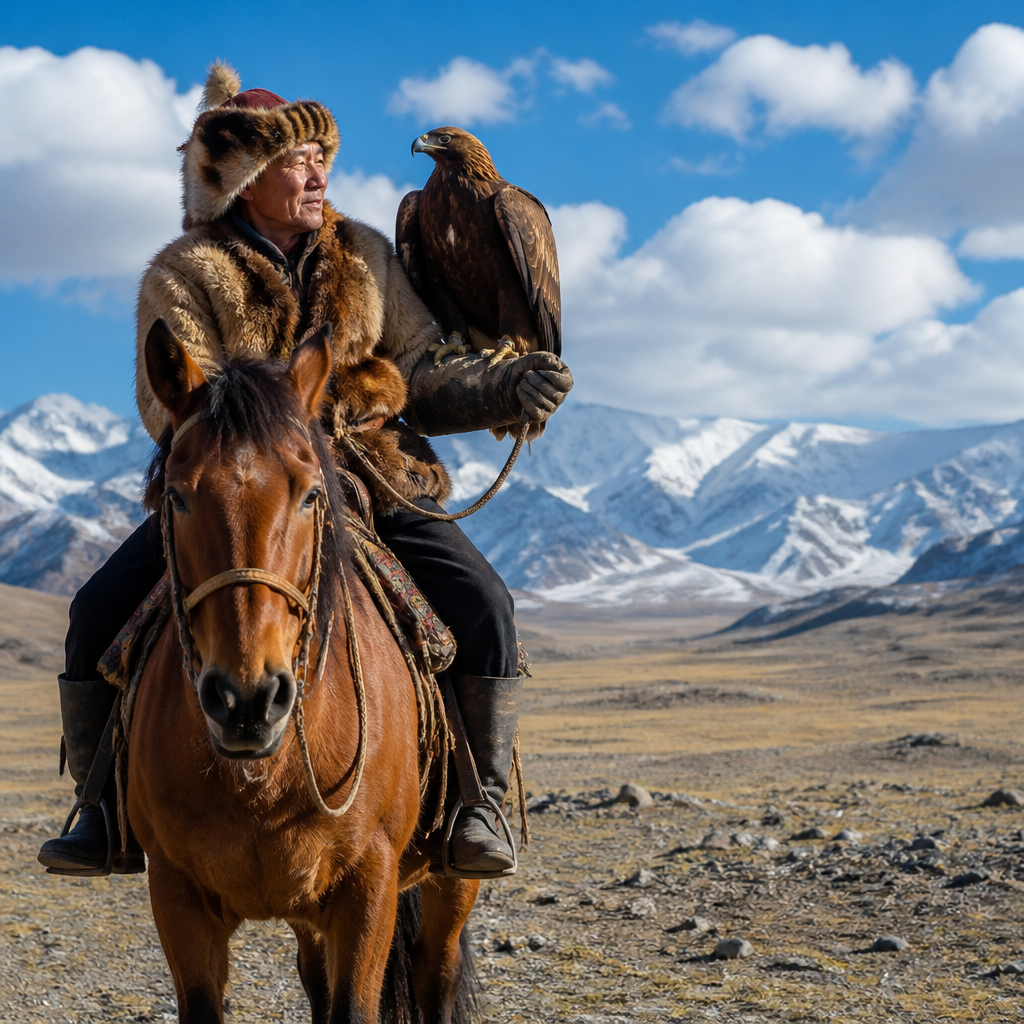
The wind in western Mongolia is a living thing. It is born on the Siberian plains, gathers strength across the endless steppe, and arrives in the Altai Mountains as a constant, scouring presence. It carves the rock, bends the sparse grasses, and carries the scent of wild thyme and dust. It’s the first thing you feel when you step off the battered prop plane in Ölgii, the last provincial capital, and the last thing you hear at night, a physical force pressing against the felt walls of your ger. This is the edge of the world, a place where maps fray and time softens.
Our destination was the Altai Tavan Bogd National Park, a remote wilderness pressed against the borders of China and Russia. Here, the landscape forgets modesty. It is a geology of giants, a place of profound scale that renders human ambition insignificant. The Tavan Bogd, or “Five Holy Peaks,” rise like jagged teeth of ice and rock, with Khüiten Peak, Mongolia’s highest point, reigning over them all. Below them, the Potanin Glacier—a colossal river of ice, twenty kilometers long—creaks and groans, a slow-motion testament to deep time. The valleys it has carved are vast, painted in shades of ochre, sage, and slate. Rivers, milky with glacial silt, braid their way across the plains, feeding lakes so intensely turquoise they seem to have fallen from the sky.
To travel here is to recalibrate your senses. The silence is not an absence of sound, but a presence. It is so complete that you can hear the whisper of your own blood, the wingbeats of a distant lammergeier, the rustle of a marmot a hundred yards away. In this immense quiet, the world feels both emptier and more alive than ever before.
Echoes of the Eagle Hunters
Beyond the staggering landscape, we came for the people. This corner of Bayan-Ölgii province is the home of the Kazakhs, a semi-nomadic people whose culture is distinct from the Khalkh Mongols who form the country's majority. And among them are the Burkitshi—the eagle hunters. To meet one is to shake hands with a tradition that stretches back thousands of years.
We found ourselves invited into the ger of a hunter named Aralbai. His face was a map of his life, etched by wind and sun, but his eyes held a startling warmth. On a perch beside his home sat his eagle, a magnificent female Golden Eagle, tethered by a leather jess. She was enormous, her gaze a piercing, intelligent yellow. Aralbai spoke of her not as a tool or a pet, but as a partner, a family member. The bond is forged over years, a deep, symbiotic trust built on a shared language of whistles, calls, and subtle gestures.
These hunters don't train eagles from the nest. They take a female fledgling, knowing she is the fiercer hunter, and work with her for six or seven years. Together, they hunt foxes and hares through the brutal winter, the eagle’s sharp eyes and the hunter’s knowledge of the land working in perfect concert. Then, in a final act of respect, they release the eagle back into the wild, so she may breed and live out her days in freedom. It is a cycle of profound respect for the natural world.
Inside Aralbai’s ger, his wife served us suutei tsai, the salty milk tea that is the lifeblood of the steppe, along with hard cheese and fresh bread. Through a translator, stories unfolded—of harsh winters, of legendary hunts, of a life lived in rhythm with the seasons. It was a powerful reminder that some of the world’s most enduring traditions are not found in museums, but are lived out daily in its wildest corners.
The Pilgrim's Path
The only way to truly experience the Altai is to move through it slowly. Our own pilgrimage was on the backs of short, sturdy Mongolian horses, animals as tough and resilient as the land they inhabit. Days fell into a simple, meditative rhythm: wake with the sun, ride for hours through breathtaking emptiness, and make camp as the alpine glow painted the peaks in shades of rose and gold.
The trek is not without its hardships. The weather is a fickle character, capable of shifting from brilliant sunshine to a blizzard in a matter of minutes. The riding is demanding, the terrain often treacherous. Muscles ache, skin gets chapped by the wind. Yet the physical effort peels away the layers of modern life. Out here, there are no emails, no deadlines, no notifications. Your only alert is the changing light, your only feed is the landscape scrolling past. It’s a forced mindfulness that leaves you feeling more connected to yourself and the present moment than you have in years. You begin to notice the small things: the fractal patterns of lichen on a rock, the delicate bloom of an alpine flower, the way the stars seem close enough to touch in the ink-black sky.
A Fragile Horizon
But even in this fastness, the modern world whispers at the edges. The eagle hunting tradition, while resilient, is fragile. Of the few hundred hunters left, most are old men. Their children feel the pull of the city, of education and easier lives in the capital, Ulaanbaatar. Aralbai admitted his own sons were more interested in motorcycles than in horses.
Simultaneously, the land itself is changing. The Potanin Glacier is visibly retreating, a stark and lonely casualty of a warming planet. Increased tourism, while providing a vital income for families like Aralbai’s, presents its own challenges, threatening to dilute the very authenticity visitors come to seek. How do you share a culture without turning it into a commodity? How do you preserve a way of life that depends on a wilderness that is itself under threat?
There are no easy answers on the steppe. There is only the quiet dignity of the people, the immense scale of the land, and the poignant beauty of a culture balanced on a precipice. The future of the Altai is a story being written now, by the people who live here and by those of us who pass through.
As we rode away from Aralbai’s camp on our final morning, he stood outside his ger, his eagle on his arm. He raised his free hand in a silent farewell. The image—of man and bird, silhouetted against the vast, morning-lit valley—was one of perfect harmony, a fleeting vision of an ancient world. A journey to the Altai is more than a trip; it is an education in resilience, a lesson in what it means to belong to a landscape. You leave a piece of your heart on the steppe, and in return, you carry a piece of its vastness within you forever.
<!-- seo-rank-booster:v1 -->Frequently Asked Questions
Who are the eagle hunters of Mongolia?
The eagle hunters, or Burkitshi, are a group of ethnic Kazakhs living in Mongolia's far-western Bayan-Ölgii province. They are renowned for their ancient tradition of hunting with trained golden eagles, a practice passed down through generations. This unique cultural heritage is a deep, symbiotic partnership between the hunter and their eagle.
Where can you see eagle hunters in Mongolia?
The heartland of eagle hunting is in the Altai Mountains, specifically within the Bayan-Ölgii province near the provincial capital of Ölgii. Travelers seeking to witness this tradition often journey to remote areas like the Altai Tavan Bogd National Park. Many families welcome visitors, offering a glimpse into their nomadic lifestyle.
How do eagle hunters train their eagles?
The process is built on trust and respect, not domination. Hunters take a female fledgling from a nest, as females are larger and fiercer hunters. Over several years, they forge a deep bond through a shared language of calls and gestures, hunting together through the harsh winters before eventually releasing the mature eagle back into the wild to breed.
What is the Altai Tavan Bogd National Park known for?
Altai Tavan Bogd National Park is a landscape of epic scale, known for the Tavan Bogd (Five Holy Peaks), including Khüiten Peak, Mongolia’s highest point. It is a remote wilderness featuring massive glaciers like the Potanin Glacier, vast valleys, and turquoise lakes. The park is also a core part of the Kazakh cultural homeland, where the eagle hunting tradition thrives.
Is it ethical to visit the Mongolian eagle hunters?
Ethical tourism is possible when approached with respect. Responsible visits involve hiring local Kazakh guides and supporting families directly, rather than through large, detached tour operators. By engaging respectfully, you can help ensure that tourism benefits the community and supports the continuation of their unique cultural traditions.
Related on Bucketlist Field Guide
- Harding Icefield Trail — Experience another immense landscape of ice and rock on this challenging trek to a massive icefield in Alaska.
- Hoh River Trail to Blue Glacier — For another journey to a remote glacier, follow this trail through temperate rainforest to the base of a stunning river of ice.
- The Iceline Trail — If you're inspired by the Potanin Glacier, this Canadian Rockies trail offers breathtaking, non-technical views of glaciers and peaks.
- Plain of Six Glaciers Trail — Trek through a valley carved by ice with incredible views of hanging glaciers, much like the valleys of the Altai.