
Where Dragons Sleep: Hiking the Lofoten Wall
Beyond the Arctic Circle, a chain of Norwegian islands rises from the sea like a dragon's spine. We journey to Lofoten, a land of impossible peaks, ruby-red fishing cabins, and a sun that refuses to set, to discover a landscape that redefines the very edge of the world.
The first glimpse of Lofoten is not a gentle introduction. From the deck of the Bodø ferry, it appears as a single, serrated silhouette against the northern sky—a formidable barrier of granite known as the Lofotenveggen, the Lofoten Wall. It doesn’t look like a place for people. It looks like a place for myths, a final, jagged line drawn between the known world and the raw, untamed Arctic. Yet, as the ferry draws closer, the wall resolves. Gaps appear, revealing channels of impossible turquoise water. Tiny clusters of color—ruby-red, mustard-yellow—harden into fishing villages clinging precariously to the shore. The myth becomes a map, and the invitation is clear: come and walk the spine of the sleeping dragon.
Our home base is a rorbu in the village of Reine, arguably the most photographed hamlet in all of Norway. These traditional fishermen’s cabins, built on stilts over the water, are the heart of Lofoten’s identity. For centuries, they housed fishermen who came for the winter cod (skrei) migration, a seasonal bounty that built fortunes and shaped a culture. Our cabin, modernized with a heated slate floor and a picture window that frames the iconic peak of Olstind, still hums with the ghosts of its past. The air outside carries the faint, briny scent of the sea and drying cod, which hang like strange, pale specters on vast wooden racks called hjell. To stay here is to live by the rhythm of the tides, to watch the shifting light paint the mountains in a thousand shades of grey, purple, and gold, and to feel an umbilical connection to the water that gives and takes in equal measure.
Ascending the Spine
But we came to climb. The trails of Lofoten are not gentle, meandering paths. They are aggressive, vertical assertions, often scrambling straight up the fall line of a mountain. The reward for this effort is a perspective that borders on the divine. Our target is Reinebringen, a modest summit by alpine standards at only 448 meters, but one that offers a view of legendary proportions.
The trail begins unassumingly before transforming into a Sisyphean staircase of stone, a remarkable feat of Sherpa engineering designed to protect the fragile terrain from the boots of pilgrims like us. There are 1,978 steps. You count them, at first. Then you lose track, focusing only on the burning in your quads and the rhythm of your breath. The world shrinks to the stone in front of you, the grip of your hand on the rock, the encouraging nod from a descending hiker whose blissful expression promises that the ordeal is worth it.
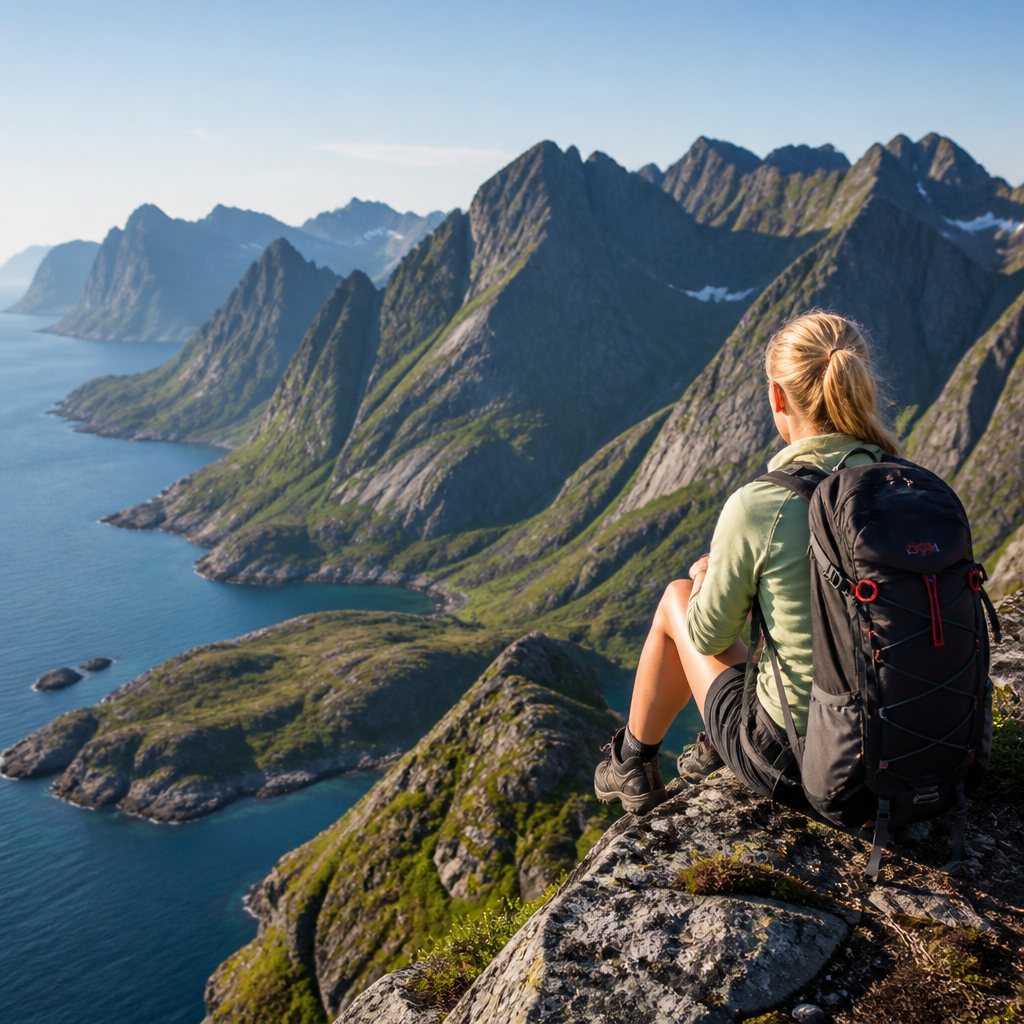
And then, you are there. The final step gives way to a narrow ridge, and the world simply falls away. Below, the village of Reine is a scattering of toys. Fjords, the color of liquid sapphire, weave between a pantheon of granite spires that claw at the sky. Olstind, Festhatten, Helvetestinden—the names themselves are incantations. It is a cartographer's dream, a landscape so dramatic and complex it feels less like a place on Earth and more like a planet from a forgotten science fiction novel. We sit for an hour, wordless, watching as wisps of cloud snag on the razor-sharp ridgelines and tiny fishing boats etch fleeting white lines on the water far below. This is not a view you simply see; it is a view you feel in your bones, a visceral reminder of geological time and your own fleeting, fragile place within it.
In the Realm of the Unsetting Sun
To experience Lofoten in summer is to lose all sense of conventional time. From late May to mid-July, the sun never dips below the horizon. The tyranny of the clock dissolves, replaced by a long, golden dream state. Midnight feels like late afternoon. Two in the morning carries the soft, ethereal glow of dusk. This perpetual light changes everything. It energizes, it disorients, and it opens up a new world of possibility.
A midnight hike is no longer a logistical challenge but a spiritual one. We find ourselves kayaking through the Kirkefjord at 1 a.m., the water a mirror of molten gold reflecting the sun-kissed peaks. The only sounds are the dip of our paddles and the lonely cry of an oystercatcher. The world is both asleep and wide awake. This endless day seeps into your soul, encouraging a slower, more observant pace. You stop watching the clock and start watching the light, noticing how its angle and color transform the landscape from one hour to the next. It’s a profound shift in consciousness, a liberation from the rhythm of dark and light that has governed human life since its inception.
A Taste of the Arctic Landscape
Life this far north is about embracing what the landscape provides, and the food of Lofoten is a testament to this principle. While the image of dried cod is pervasive, the modern culinary scene is a revelation. In a small restaurant in the village of Sørvågen, we eat lamb that has grazed on salt-sprayed coastal grass, its meat infused with the terroir of the islands. We find rich, caramelized brown goat cheese (brunost) served with cloudberry jam, the tart, amber-colored berries foraged from the high moors. We feast on halibut pulled from the fjord that morning, served simply with new potatoes and butter, its freshness so profound it feels like a direct communion with the sea.
This is not fussy, overwrought cuisine. It is elemental. It is food that tastes of its origin—of cold, clean water, of wind-swept hillsides, of long summer light. It is the perfect nourishment for a body weary from hiking and a soul overwhelmed by beauty. To eat here is to understand that the starkness of the landscape belies an incredible, resilient richness.
Leaving Lofoten is a slow, reluctant process. As the ferry pulls away, the wall reassembles itself, the villages dissolving back into specks of color, the individual peaks merging once more into that single, mythical silhouette. But it’s different now. You know what’s hidden in those gaps. You have felt the chill of that water, stood on those impossible summits, and lived for a moment in that endless light. The dragon is no longer a creature of myth. You have walked its spine and felt its heart beating beneath your feet, and its rhythm will stay with you long after you’ve returned to the world of setting suns.