
Walking into Stillness: A Journey on Japan's Kumano Kodo
For over a millennium, emperors and pilgrims have walked the Kumano Kodo, a network of sacred trails weaving through the dense, myth-laden forests of Japan’s Kii Peninsula. In a world saturated with digital noise, this ancient path offers a rare pilgrimage: not just toward a set of shrines, but toward a profound and tranquil silence.
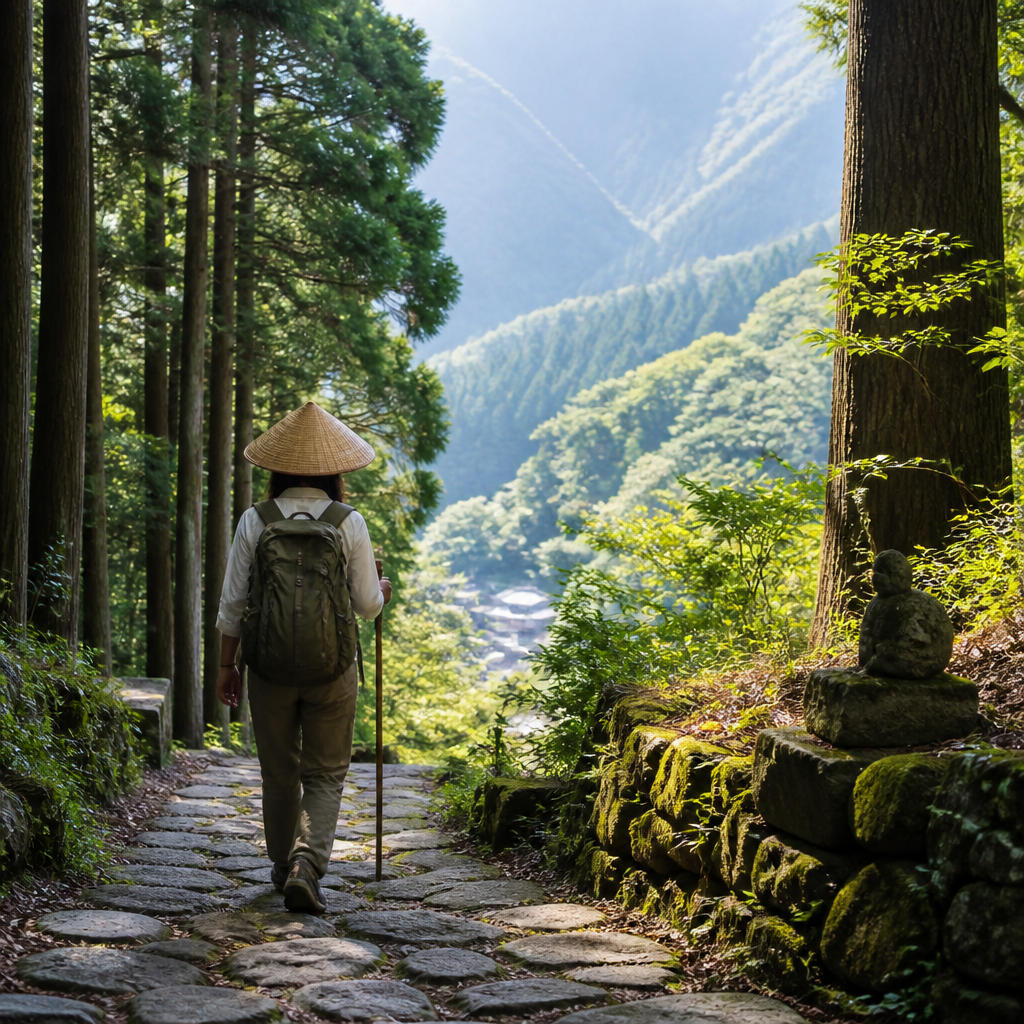
The first step is a contract, an agreement made with the air and the earth. One moment, you are in the civilized hum of a Japanese train station; the next, you are at the foot of a path that dissolves into a deep, primeval green. The air changes instantly, losing its modern sharpness and taking on the scent of damp soil, hinoki cypress, and something else—something ancient and reverent. This is the threshold of the Kumano Kodo, a network of pilgrimage routes lacing through the mountainous Kii Peninsula, just south of Osaka’s urban sprawl. For over a thousand years, this has been a landscape of devotion, a place where the journey itself is the destination.
To walk the Kumano Kodo is to step into a living history book. It is one of only two pilgrimages designated as a UNESCO World Heritage site, the other being the Camino de Santiago. But where the Camino traverses open plains and towns, the Kumano Kodo plunges you into the very heart of Japan’s spiritual landscape. These are the paths of seeking, walked by retired emperors in gilded palanquins, ascetic mountain monks in straw sandals, and humble peasants praying for a good harvest. They came to honor the Kumano Sanzan, the three Grand Shrines—Hayatama Taisha, Nachi Taisha, and the central Hongu Taisha—at the confluence of sacred rivers.
A Path Etched in Time
The routes were born from a unique syncretism of Japan's native Shintoism, which sees deities (kami) in natural phenomena like ancient trees and waterfalls, and imported Buddhism. On the Kumano Kodo, these two faiths don’t just coexist; they intertwine. Buddhas were seen as manifestations of Shinto kami, creating a rich spiritual tapestry. The journey wasn't just about reaching the shrines but about moving through a landscape where the divine was immanent. Small stone signposts, moss-covered jizo statues protecting travelers, and diminutive Oji shrines—subsidiaries of the main shrines—dot the trail every few kilometers. They are not merely rest stops; they are punctuation marks in a long, contemplative sentence, places to pause, offer a coin, and realign oneself with the spirit of the path. To walk here is to feel the weight and grace of a million journeys that came before, their intentions soaked into the very soil.
The Texture of the Trail
The experience of the Kumano Kodo is intensely physical, a conversation between your body and the terrain. The trail is rarely flat. It climbs and descends on uneven stone steps, or ishidatami, laid centuries ago to combat erosion and aid drainage. Their surfaces are slick with moss, demanding a focused, deliberate placement of each foot. You are forced to slow down, to pay attention not to your phone or your thoughts, but to the contact between your boot and the stone. Towering Japanese cedar (sugi) and cypress (hinoki) trees, some many hundreds of years old, form a dense canopy that filters the sunlight into a cathedral-like gloom. The forest breathes around you. You hear the percussive drip of water from fern fronds, the call of a distant bird, the rustle of a tanuki in the undergrowth, and, most profoundly, the sound of your own breath and heartbeat. The world shrinks to the next step, the next marker, the next lungful of clean, cool air. This is a walking meditation, enforced by the beautiful rigor of the trail itself.
Encounters in the Mist
As dusk begins to settle, the path delivers you to a small village nestled in a valley. The reward for a day’s effort is not just rest, but immersion. Staying in a family-run minshuku or a traditional ryokan is integral to the Kodo experience. Here, the modern world falls away completely. You trade your hiking clothes for a simple cotton yukata, slide open a paper screen to a view of a misty river, and descend to the onsen. Soaking in the geothermally heated, mineral-rich water is a ritual of purification and restoration. Your aching muscles surrender to the heat, your mind unclenches, and you emerge feeling reborn, ready for dinner. The meals are a form of art—a meticulously arranged collection of local, seasonal dishes. Mountain vegetables, grilled river fish, house-made tofu, fragrant rice. It is food that tells the story of the place you just walked through. You might share a table with a retired couple from Kyoto or a solo hiker from Germany, all of you bound by the shared effort of the day, communicating through gestures and a common sense of tired, happy fulfillment.
The Arrival and the Afterimage
The culmination of the Nakahechi route, the trail's imperial path, is the dramatic approach to Kumano Nachi Taisha. The final, lung-busting stone staircase brings you to the shrine's vibrant vermillion halls, but the true prize is the view beyond: a spectacular three-tiered pagoda seemingly floating in front of Nachi-no-Otaki, Japan’s tallest waterfall. The cascade drops 133 meters in a single, unbroken stream, a powerful embodiment of the Shinto kami it represents. Standing there, listening to the roar of the water, you don't feel a sudden, lightning-strike epiphany. Instead, the feeling is one of a slow-blooming quiet, an internal spaciousness that has been cultivated over days of walking. The goal was not the shrine itself, but the person you became on the way to it.
In an age of relentless connectivity and speed, the Kumano Kodo offers a radical antidote. It is an act of pilgrimage against the hurried rhythms of modern life, an invitation to disconnect from the digital and reconnect with the physical world, your own body, and the deep, silent pulse of history. You return to the world of bullet trains and neon cities, but the afterimage of the trail remains: the feel of a mossy stone under your hand, the scent of cedar on the air, and the echo of a profound, well-earned stillness.