
The Silence and the Sound: Charting a Course Through Haida Gwaii
On the misty edge of the North American continent, the islands of Haida Gwaii hold a silence that speaks volumes. It’s a journey into a world of towering cedar, watchful totems, and a culture woven inextricably into the land and sea, offering not just an adventure, but a profound recalibration of the soul.
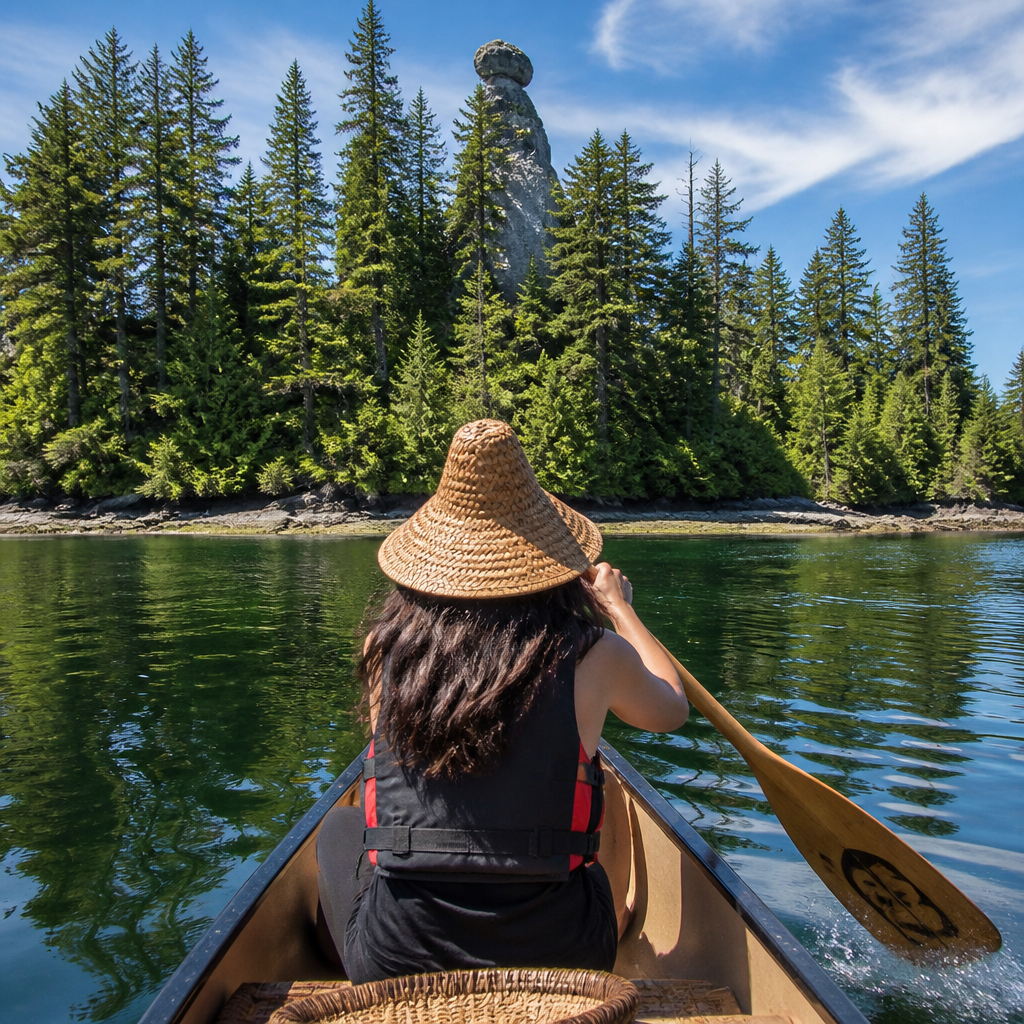
The approach is a surrender to gray. The sky melts into the sea, and the sea into the sky, a strata of mist and stillness broken only by the dark, serrated line of the horizon. This isn't just an arrival; it's an immersion. To set foot on Haida Gwaii, the archipelago of over 150 islands that dangles off the coast of northern British Columbia, is to feel the modern world recede like a fading tide. Known for millennia as X̱aayda Gwaay, “Islands of the People,” and for a brief, colonial moment as the Queen Charlotte Islands, this place demands a different kind of presence. You don’t conquer a landscape here; you are accepted by it. You learn to listen to the silence and to the riot of sound that fills it: the guttural croak of a raven, the sigh of wind through thousand-year-old Sitka spruce, the percussive crash of Pacific waves on stone.
The Geography of Myth
Haida Gwaii exists in a state of primal splendor. It is a world sculpted by water and time, a temperate rainforest so vibrant it feels sentient. The air is heavy with petrichor and the sweet, resinous scent of cedar. Everything is draped in a thick, emerald cloak of moss, which muffles sound and softens every edge, from fallen logs the size of small whales to the gnarled branches of ancient trees. This is the Galápagos of the North, a place of remarkable biodiversity and unique subspecies. The Haida Gwaii black bear, larger and with a more pronounced rostrum than its mainland cousins, ambles along shorelines littered with storm-tossed bull kelp. Stickleback fish in the island’s landlocked lakes have evolved into distinct species, a living lesson in natural selection.
The true ruler, however, is the ocean. Hecate Strait, the notoriously tempestuous body of water separating the islands from the mainland, serves as a formidable guardian, shaping the weather, the culture, and the very spirit of the place. On the western coast, the Pacific stretches, unbroken, to Japan. Its swells have carved the shoreline into a dramatic fretwork of exposed cliffs, sea stacks, and secluded, crescent-shaped beaches where polished stones outnumber grains of sand. To travel here is to be in constant dialogue with the water. Tides can swing over twenty feet, revealing vast, life-filled flats and then swallowing them again, dictating every departure and arrival.
A Living Culture Carved in Cedar
To experience Haida Gwaii is to witness the indivisible bond between a people and their homeland. This is not a wilderness devoid of human story; it is a landscape dense with narrative, history, and spirit. The most potent and humbling testament to this is found in the southern reaches of the archipelago, within the Gwaii Haanas National Park Reserve, National Marine Conservation Area Reserve, and Haida Heritage Site.
Here, at village sites like SGang Gwaay Llanagaay (“Wailing Island”), a designated UNESCO World Heritage Site, time behaves differently. Standing before the city of mortuary and memorial poles is a profoundly moving experience. Carved with the crests of the raven, the eagle, the grizzly bear, and the sculpin, these immense cedar sentinels are not preserved in a sterile, museum-like state. They are allowed to live out their natural cycle, slowly weathering, leaning, and returning to the mossy earth from which their trees first grew. They are not relics of a lost culture, but markers of a continuing one, their silent watch over the empty longhouse depressions a testament to resilience and permanence.
This connection is made palpable by the Haida Watchmen. During the summer months, guardians from the Haida Nation live at these ancient sites. They are not guides in the traditional sense, but hosts. To sit with a Watchman by a crackling fire, sharing stories as you look out over the same cove their ancestors fished for millennia, is the true heart of the journey. They share the history of the poles, the protocols of visiting their ancestral home with respect, and the contemporary story of a nation reclaiming its heritage and stewardship. In their presence, you cease to be a tourist and become a witness.
Navigating the Edge
There are no roads into Gwaii Haanas. Access is by sea or air only, a logistical filter that preserves its sanctity. For the wilderness traveler, this means a journey by expedition vessel or, for the truly committed, by kayak. Paddling through these waters is an exercise in humility and awe. On a calm day, the kelp forests sway in the turquoise shallows, and your paddle dips into water so clear you can count the purple and orange legs of a sunflower sea star twenty feet below. An eagle might circle overhead, its white head a stark contrast against the dark green canopy. A harbor seal’s curious face might pop up beside your boat, a moment of interspecies connection that feels both startling and graceful.
Then, the weather can turn. The wind picks up, the sky darkens, and the gentle swell becomes a formidable chop. You paddle harder, feeling small and insignificant against the raw power that has shaped this land. It is in these moments—hunkered down on a wild beach waiting for a storm to pass, or navigating a channel as a pod of humpback whales breaches in the distance—that the adventure crystallizes. It’s a physical and mental challenge that strips away a traveler’s artifice, leaving a more fundamental, attentive self. Each meal cooked over a driftwood fire, each night spent listening to the rain drum on the tent, feels earned and vital.
The Resonance of Return
The silence of the old villages is not an empty one. It is filled with the weight of stories, the memory of voices, and the enduring presence of the spirits carved into the poles. And it is amplified by the constant, living soundscape that envelops it: the crash and whisper of the tide, the cry of gulls, the deep exhalation of a surfacing whale. Haida Gwaii teaches you to listen, to observe, and to understand that some of the most powerful stories are told without words. To return from these islands is to carry that resonance with you. The world feels louder, faster, more cluttered. You find yourself seeking the quiet moments, the deep breaths, the connection to something more ancient and elemental than the daily grind. It’s more than a destination; Haida Gwaii is a lesson in permanence, resilience, and the profound beauty of a world where culture and nature are one and the same.