
The Sapphire Line: Finding Stillness in Norway's Lofoten Islands
Beyond the Arctic Circle, a string of Norwegian islands rises from the sea like a dragon's spine. Here, in the Lofoten archipelago, sheer granite walls meet turquoise water, and the rhythm of life is dictated by the tide, the trail, and the otherworldly light.
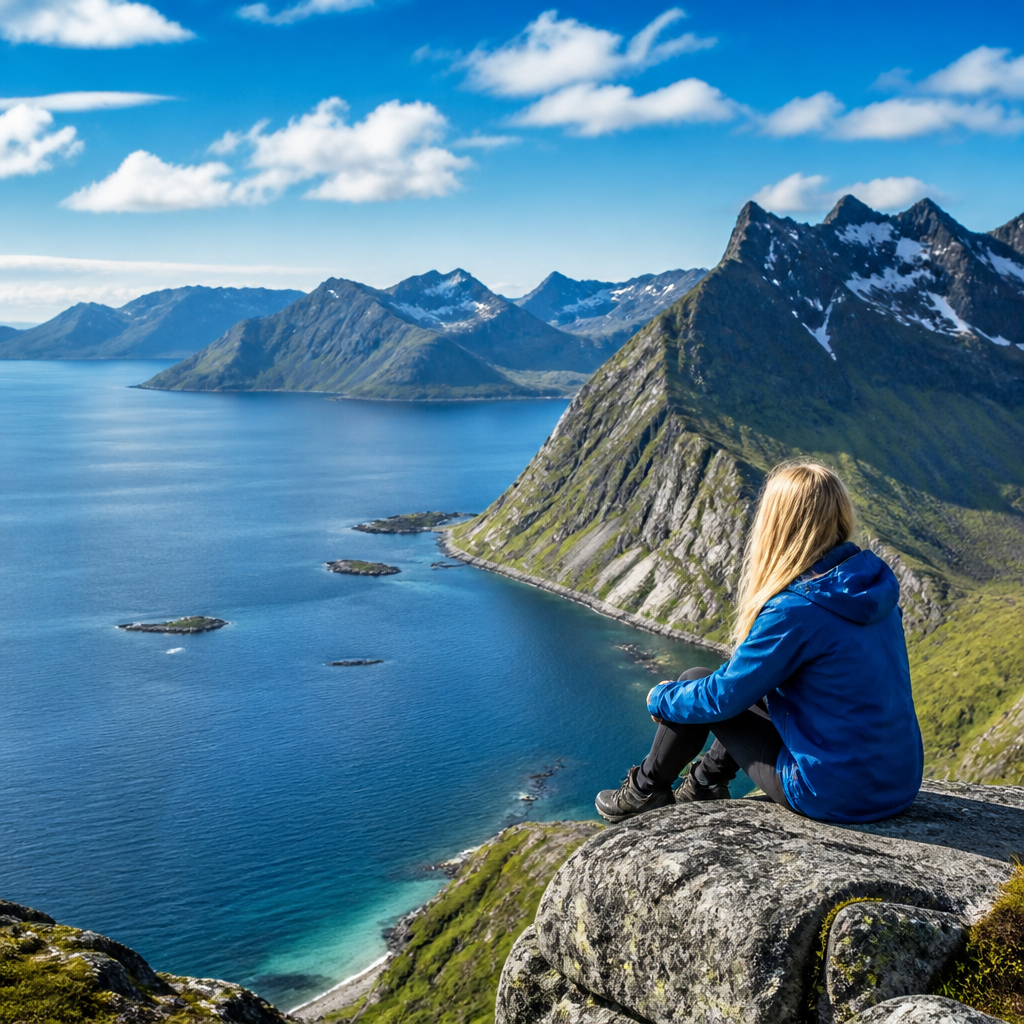
The approach by air is a study in disbelief. One moment, there is only the steely grey of the Norwegian Sea; the next, a serrated line of impossible peaks tears through the clouds. They don't roll or rise; they erupt. This is the Lofoten Wall, a 160-kilometer-long spine of ancient granite that forms the backbone of an archipelago lying entirely within the Arctic Circle. To arrive here is to feel you’ve crossed a threshold into a landscape from myth, a place where the ordinary rules of geography have been thrillingly suspended.
From the ground, the sensation is only amplified. The scale is monumental, almost confrontational. Peaks that climbers would spend days assaulting elsewhere are here simply the backdrop for a quiet fishing village. Roads cling to the coastline, weaving between the unyielding stone and the tidal water, connecting hamlets of bright red cabins like beads on a string. This is not a gentle land, but it possesses a profound, almost severe beauty that quiets the mind and quickens the pulse.
A Landscape Etched in Granite
To understand Lofoten is to understand its violent, glacial birth. The mountains are among the oldest in Europe, gnarled relics of a tectonic collision over 400 million years ago, later scoured and sharpened by the immense power of Ice Age glaciers. When the ice receded, the sea flooded the deep, U-shaped valleys, creating the dramatic fjords and sounds that define the islands today. The result is a landscape of stark contrasts: the dark, weathered granite of the peaks against the impossible sapphire and turquoise of the water in a shallow bay; the lush green of a summer pasture nestled beneath a sheer, thousand-foot cliff.
The sea is not a passive element here; it is the lifeblood and the sculptor. The Vestfjord, which separates Lofoten from the mainland, is notoriously turbulent, a cauldron of currents and weather. Yet within the archipelago’s embrace, sheltered inlets offer moments of crystalline calm. The water temperature, moderated by the last vestiges of the Gulf Stream, allows for a surprising abundance of life, and on a still day, its clarity is astonishing. You can gaze down from a bridge and see schools of coalfish darting through kelp forests ten meters below, a perfect, living aquarium.
The Cadence of Cod and Cabin
For over a millennium, life in Lofoten has pulsed to a single, powerful rhythm: the annual migration of the skrei, the Arctic cod. Every winter, vast shoals journey south from the Barents Sea to spawn in the islands’ relatively sheltered waters. This predictable bounty transformed these remote islands into a vital economic engine for Norway. Fishermen from across the country would descend upon Lofoten, living for months in simple shoreline cabins known as rorbuer.
Today, the fishing industry continues, but many of these iconic rorbuer, perched on stilts over the water, have found a new purpose. Beautifully restored, they offer travelers a direct connection to the islands’ heritage. To stay in a rorbu is to inhabit that history. You wake to the cry of gulls and the scent of salt and brine. You watch the fishing boats chug out of the harbor as you sip your morning coffee, their engines a familiar thrum against the silence. Outside, you’ll still see the hjell—huge wooden A-frame racks where cod is hung to dry in the cold, windy air, slowly transforming into the delicacy known as stockfish. The practice is ancient, and the sight of these vast fish-cathedrals against a mountain backdrop is an indelible Lofoten image.
The Vertical Ascent to Reinebringen
While the sea defines life, the mountains offer pilgrimage. Hiking in Lofoten is a vertical affair. Trails are often steep, direct, and exceptionally rewarding. Perhaps none is more iconic than the ascent of Reinebringen, the 448-meter peak that looms over the village of Reine, arguably the most picturesque spot in the entire archipelago.
What was once a treacherous scramble up a muddy goat path has been transformed by the Herculean efforts of Nepalese sherpas into a remarkable stone staircase. The climb is a breathless, leg-burning meditation of nearly 2,000 steps. There are no switchbacks, only the rhythmic clink of trekking poles on stone and the deepening panorama behind you. You ascend alongside waterfalls of scree, clinging to the mountain’s flank. The effort is intense, but the reward is sublime.
Stepping onto the summit ridge is one of the great reveals in European hiking. The world falls away into a breathtaking tapestry of land and water. The village of Reine, with its red and white cabins, is scattered across a series of tiny islets, all connected by elegant bridges and encircled by a lagoon of pure turquoise. Beyond, a crown of granite peaks—Olstind, Helvetestinden, Storskiva—stand like sentinels guarding the entrance to the Kirkefjord. From this vantage point, you finally grasp the fractal geometry of Lofoten, the intricate filigree of water weaving through stone. You feel less like you’ve conquered a mountain and more like you’ve been granted a divine perspective.
Whispers on the Water
To see the mountains from the sea is to understand them anew. From the cockpit of a sea kayak, the granite walls you just looked down from now tower over you, their full, intimidating scale made manifest. Paddling into a fjord like Kirkefjord or the tranquil bay of Bunes Beach offers an intimacy the summits cannot. The world shrinks to the sound of your paddle dipping into the clear, cold water, the faint trickle of a waterfall high on the cliffs, the sharp cry of an Arctic tern.
This is where you feel the quiet heart of the islands. You can glide silently past colonies of puffins, their comical-serious faces watching you from a grassy bank. If you’re lucky, a white-tailed sea eagle, with its colossal wingspan, might soar from its aerie high above, circling effortlessly on the updrafts. Here, on the water, you are a guest in a wild kingdom, a small, humble presence in an immense and ancient space. Time slows down, measured not in hours but in the gentle rocking of the tide and the slow transit of clouds across a jagged ridgeline.
Lofoten lodges itself in your memory through this interplay of scales—the epic and the intimate. It’s the feeling of being infinitesimally small beneath a towering mountain, followed by the quiet joy of spotting a tiny, perfect seashell on a white sand beach. It’s the raw power of a storm in the Vestfjord contrasted with the ethereal, unending light of the midnight sun, which bathes the landscape in a soft, golden glow for weeks on end. It is a place that demands your full attention, your physical effort, and your sense of wonder. In return, it offers a profound sense of peace—a stillness found not in the absence of challenge, but at the very heart of it.
<!-- seo-rank-booster:v1 -->Frequently Asked Questions
What are the Lofoten Islands famous for?
The Lofoten Islands are famous for their dramatic scenery where sheer granite mountains rise directly from the sea. They are also known for their picturesque fishing villages, traditional red rorbuer (fishermen's cabins), the Northern Lights in winter, the midnight sun in summer, and their historical connection to Arctic cod fishing.
When is the best time to visit the Lofoten Islands?
The best time to visit depends on your goals. For hiking, endless daylight, and warmer temperatures, visit during the summer months (June to August) to experience the midnight sun. For a chance to see the incredible Northern Lights (aurora borealis) and a dramatic, snow-covered landscape, plan your trip between September and March.
Is hiking in Lofoten difficult?
Many trails in Lofoten are considered challenging due to their steep, vertical nature. Routes often ascend quickly, gaining significant elevation over short distances, but reward hikers with spectacular panoramic views. Hikes like Reinebringen are iconic for their steepness and the breathtaking scenery from the summit.
Where should I stay in the Lofoten Islands?
For a truly authentic experience, many travelers choose to stay in a rorbu, a traditional fisherman's cabin often built on stilts over the water. These have been converted into cozy, modern accommodations that offer a direct link to the islands' fishing heritage. Other options include hotels and guesthouses in larger villages like Svolvær and Leknes.
Related on Bucketlist Field Guide
- Harding Icefield Trail — Experience another epic landscape shaped by glaciers on this stunning Alaskan hike.
- Precipice Trail — If you're drawn to Lofoten's vertical ascents, this exposed cliff-face trail in Acadia offers a similar thrill.
- Angels Landing — This iconic, chain-assisted hike provides the same sense of exposure and monumental views as Lofoten's best ridges.
- Kalalau Trail (Hanakapiai Falls) — For another adventure along dramatic coastal cliffs, explore this legendary and demanding trail in Kaua'i.