
The Land of Maybe: Finding Stillness on the Faroe Islands' Ancient Trails
Between the North Atlantic and the Norwegian Sea lies a scattered archipelago of 18 volcanic islands where the weather is a fickle monarch and the landscape writes its own sagas. The Faroe Islands don't offer easy escapes; they offer something better: a profound, windswept immersion into a world that demands you slow down, look closer, and embrace the beautiful uncertainty of 'maybe'.
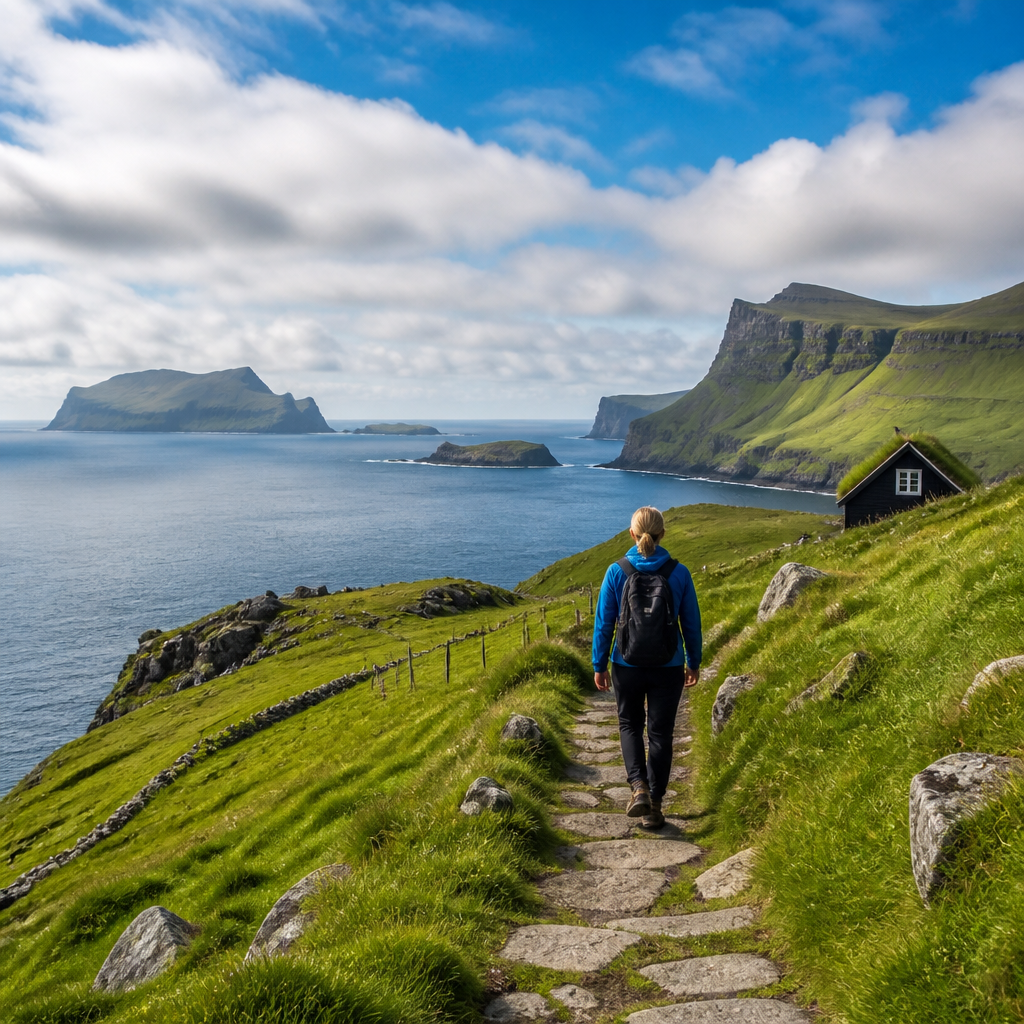
The descent into Vágar feels less like an arrival and more like a revelation. One moment, there is only the boundless gunmetal grey of the North Atlantic. The next, the clouds part to reveal impossible shapes: emerald-green buttresses of land plunging into a churning sea, houses painted in primary colors clustered in defiance of the elements, and everywhere, the white flecks of sheep clinging to near-vertical slopes. There are no trees. The thought arrives with sudden clarity. There is nothing to hide behind. This is the Faroe Islands, an autonomous archipelago adrift between Iceland and Norway, and it introduces itself with a bracing, salt-laced honesty.
To travel here is to enter a pact with uncertainty. Plans are suggestions, schedules are provisional. The reward for this surrender is not simply a collection of dramatic vistas, but a deeper recalibration of your internal rhythm—a discovery of the profound peace that can be found in the land of 'maybe.'
The Grammar of the Landscape
Hiking in the Faroes is an exercise in reading the land’s raw grammar. The trails are rarely manicured paths; they are ancient sheep tracks, faint whispers across vast, amphitheater-like valleys. The only signposts are the stone cairns, or varðar, stout, moss-covered piles that have guided shepherds and travelers for centuries. To walk here is to feel a connection to that long, unbroken lineage of passage.
Consider the pilgrimage to Sørvágsvatn, the so-called 'lake over the ocean.' The trail begins as a gentle, grassy walk before ascending towards the sea cliffs. The wind is a constant companion, a physical presence that sculpts the land and leans into you, testing your balance. As you climb, the perspective shifts. The lake, which sits just 30 meters above sea level, begins to create a powerful optical illusion, appearing to hang hundreds of feet above the waves crashing below. Reaching the precipice of Trælanípa—the 'Slave Cliff'—is a moment of pure, heart-in-your-throat awe. The drop is sheer, the air is thick with the cries of fulmars and kittiwakes, and far below, the ocean boils and seethes. In summer, the cliffs are also a bustling metropolis for puffins. Watching them, with their comical, urgent waddles and beaks stuffed with shimmering sand eels, is to witness a joyful, tenacious grip on life at the world's edge.
The landscape's scale is deceptive. A village that appears a stone's throw away might require a two-hour trek over a formidable pass. This land teaches you a different kind of measurement, one based not on miles or minutes, but on effort, weather, and light. It’s a language of presence.
A Meteorology of the Soul
There’s a well-worn Faroese saying: 'If you don’t like the weather, wait five minutes.' It's often said with a wry smile, but it's the fundamental truth of the islands. A day can cycle through brilliant sunshine, thick, world-erasing fog, lashing rain, and calm serenity, sometimes all before lunch. For the modern traveler, accustomed to optimizing every moment, this can be maddening. Here, it is the central lesson.
You might wake with plans for a strenuous ridge hike only to find your windowpane slick with rain and the view entirely consumed by a blanket of white fog. The initial pang of disappointment is a familiar one. But on the Faroes, this is not a cancellation; it’s a redirection. This is the moment you decide to drive the winding roads to the tiny, impossibly picturesque village of Gjógv, with its deep, narrow gorge that serves as a natural harbor. You find the small guesthouse, sit with a cup of strong coffee and a slice of rhubarb tart, and watch the mist swirl outside. You speak to the woman behind the counter, who tells you about her grandfather who used to guide his boat through that very gorge in storms you can’t imagine.
This is the gift of Faroese weather. It dismantles your agenda. It forces you away from the checklist and into the moment. The most memorable experiences are often the unplanned ones: the sudden sunbeam that illuminates a waterfall, the unexpected conversation in a quiet harbor, the simple warmth of a café on a cold day. You learn to stop fighting the elements and instead move with them. The 'maybe' of the forecast becomes a source of quiet anticipation, not anxiety.
The Texture of Belonging
This constant negotiation with nature has forged a culture of profound self-reliance and deep-seated community. For centuries, survival in these isolated islands depended on cooperation. That ethos endures, and for visitors, its most tangible expression is heimablídni—literally, 'home hospitality.'
This growing movement sees local families opening their homes to strangers for a traditional evening meal. To sit at a wooden table in a cozy, light-filled dining room in a village like Velbastaður, looking out as the weather rages, is to understand the soul of the Faroes. The meal itself is a narrative of the landscape. There might be ræst, the iconic wind-cured and fermented lamb, its flavor funky, complex, and utterly unique. There will be fish, perhaps cod or halibut, caught that morning from the fjord below. There will be potatoes and turnips, coaxed from the thin soil. Nothing is casual; everything tells a story of scarcity, ingenuity, and a deep respect for the source.
Over the meal, stories are shared. A farmer talks about the annual sheep roundup, a tradition that binds the community. A host points to the intricate patterns in her hand-knit sweater, a design specific to her family. You are no longer a tourist consuming a product; you are a guest participating in a culture. This intimacy, this texture of real belonging, is a powerful antidote to the anonymous consumption of modern travel.
A Modern Saga
Yet, it would be a mistake to view the Faroe Islands as a living museum, a relic preserved in Atlantic salt. This is a dynamic, forward-looking nation crafting a modern saga. The younger generation, globally connected yet fiercely proud of their heritage, are reinterpreting what it means to be Faroese.
This is evident in the music of artists like Eivør Pálsdóttir, whose haunting vocals and blend of traditional ballads with electronic soundscapes have found a global audience. It's in the groundbreaking culinary philosophy of restaurants like the two-Michelin-starred KOKS (temporarily relocated, but its ethos remains), which elevated local, foraged, and fermented ingredients to the highest echelons of gastronomy. And it's in the vibrant art scene in the capital, Tórshavn, where galleries showcase work that grapples with themes of isolation, identity, and the sublime power of nature.
To walk through Tórshavn is to see this balance everywhere: ancient, turf-roofed parliament buildings stand near Nordic-cool design shops and cafes serving world-class espresso. The Faroe Islands are not turning their back on their past; they are building upon it, writing the next chapter of their story with confidence and creativity.
Leaving the Faroes, you take more than just photographs. You take a piece of the stillness. You take the feeling of the wind on your face, the memory of the light, the taste of salt and time. You learn that the path of most resistance often leads to the most rewarding view. And you learn the value of 'maybe'—the idea that the best moments in life are often the ones you could never have planned.