
The Land of Maybe: Finding Stillness in the Faroe Islands
On the edge of the North Atlantic, a string of 18 mythic islands teaches a profound lesson in letting go. Here, where weather is the only true monarch, the greatest adventure is not in conquering the landscape, but in surrendering to its beautiful, unpredictable rhythm.
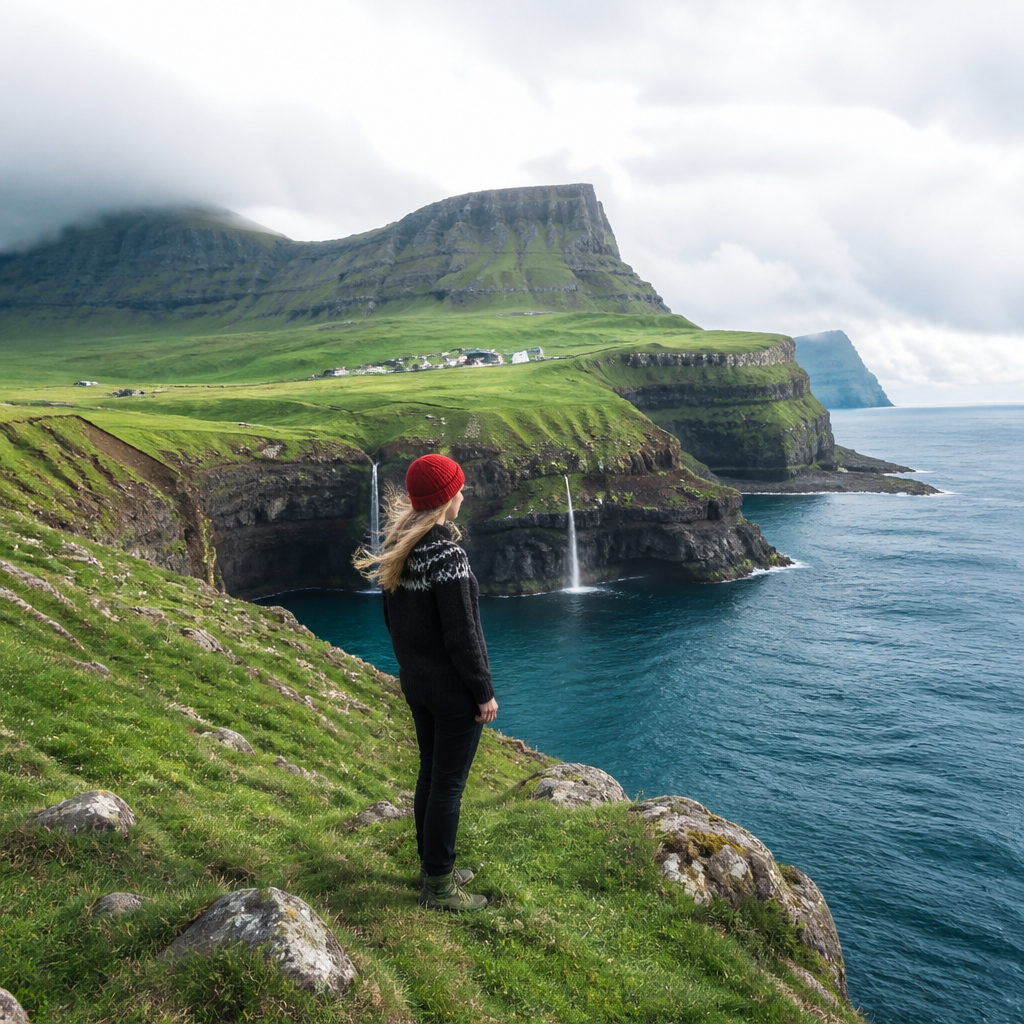
The first breath of Faroese air is a baptism. It’s sharp, heavy with the phantom scent of salt and ancient rock, and so damp it feels less like air and more like a vaporous state of the ocean itself. You arrive, as most do, by descending through a thick ceiling of cloud, a sudden tear in the pewter-grey fabric revealing a landscape of impossible green. This is the first lesson of the Faroe Islands: what seems obscured can, in a heartbeat, become astonishingly clear. And just as quickly, it can vanish again.
Locals have a name for their home, uttered with a knowing, half-resigned smile: Landið kanska. The Land of Maybe. Maybe the sun will pierce the fog for a transcendent hour. Maybe the ferry to Mykines will run. Maybe the hike you planned for months will be swallowed by a horizontal gale. Here, in this semi-autonomous archipelago adrift between Norway and Iceland, the meticulously crafted itineraries of modern travel dissolve. The weather is not a backdrop; it is the protagonist, the absolute monarch, and its whims dictate the narrative of every day. To visit the Faroes is to enter an apprenticeship in the art of surrender.
An Archipelago Sculpted by Wind and Water
The islands are the exposed crowns of a volcanic ridge, brutalized into beauty by ice and ocean. Basalt cliffs, layered like pages of a geological bible, plunge thousands of feet into a churning, slate-blue Atlantic. There are no native trees to soften the view, only an endless rolling tapestry of green, quilted by ancient stone walls and populated by some 70,000 sheep who seem to defy gravity on near-vertical slopes.
This is a place of geologic drama, where every vista feels like a set piece from a Northern saga. On Vágar, the iconic waterfall of Múlafossur at Gásadalur spills directly from a cliff into the sea, a ribbon of freshwater unbound for the salt. A short, heart-in-your-throat boat trip from Sørvágur reveals the sea stacks of Drangarnir and Tindhólmur, stone sentinels guarding the entrance to the fjord, their forms so perfect they seem sculpted by a divine, minimalist hand. Drive the buttercup roads, dipping into sub-sea tunnels that link the islands, and you’ll find yourself in villages like Saksun—a tiny cluster of turf-roofed houses huddled around a tidal lagoon, facing a starkly beautiful amphitheater of mountains. When the mist rolls in, which it often does, the world shrinks to the sound of a distant oystercatcher and the damp smell of earth. It’s a landscape that doesn’t just invite observation; it commands a feeling of profound, humbling scale.
The Rhythm of the Unpredictable
Living in a place ruled by 'maybe' cultivates a unique human terroir. The Faroese possess a quiet resilience, a practical stoicism born from generations of making a life on the edge of the world. They are fishermen who read the water, farmers who know the wind. Their connection to this place is not one of conquest, but of deep, symbiotic understanding. Plans are held loosely. A storm that cancels a day’s fishing is simply an opportunity to mend nets, to share a pot of coffee, to exist in the moment that is, not the one that was hoped for.
This adaptability extends into one of the islands' most cherished traditions: heimablídni, or 'home hospitality.' On a whim, you might find yourself invited into a family’s home for a multi-course meal of fermented lamb, wind-dried fish, and potatoes pulled from the soil just outside. Sitting at a communal table in a centuries-old farmhouse, sharing stories with strangers who feel like old friends, you realize that the most memorable experiences here are rarely the ones you can schedule. They are born from the unexpected pause, the shift in plans dictated by a sudden squall. The fog that grounds you in a small village isn't a nuisance; it's an invitation. An invitation to knock on the door of the local knitwear artisan, to linger over coffee in a Tórshavn café, to simply sit by the harbor and watch the trawlers come and go, their hulls painted in brilliant blues and reds against the grey water.
Tracing Ancient Paths
Before the tunnels and modern roads, the only way between villages was on foot, over the high, treeless fells. These ancient pathways, or bygdagøtur, are still traced across the landscape, marked by meticulously maintained stone cairns known as varðar. To hike one of these routes is to step into the quiet heartbeat of the islands.
The path from Saksun to the Viking-age village of Tjørnuvík is one such pilgrimage. It begins by the quiet lagoon and ascends sharply, leaving the toy-like houses behind. Up on the fell, there is nothing but the wind, the springy turf underfoot, and the cairns marching faithfully across the green expanse. With each step, the modern world feels more distant. The silence is immense, broken only by your own breathing and the melancholic cry of a curlew. Looking down from the pass, Tjørnuvík’s black sand beach appears far below, the North Atlantic waves unfurling in hypnotic white lines. You are walking through history, guided by the same stone markers that have led shepherds, priests, and lovers for a thousand years. It’s a form of moving meditation where the goal is not the destination, but the elemental immersion along the way.
The Still Point of a Turning World
One does not leave the Faroe Islands with a tan or a simple collection of photographs. One leaves with a recalibrated internal compass. This is the gift of the 'Land of Maybe.' It's the slow, dawning realization that our obsession with control, with fixed plans and predictable outcomes, is a fragile illusion. The islands gently, persistently, teach you to find joy not in a perfectly executed itinerary, but in the beauty of the unexpected detour.
You learn to celebrate the five minutes of golden light between cloudbursts as a miracle. You learn that a canceled ferry can lead to the best conversation of your life. Standing on a cliff at Kallur Lighthouse, watching the fog swirl and retreat, you don't feel cheated by the obscured view. Instead, you feel a part of something larger—a dynamic, breathing world that operates on its own magnificent terms. The 'maybe' ceases to be a source of anxiety and becomes an emblem of possibility. And in that surrender, you find a profound and quiet stillness you didn’t even know you were searching for.
<!-- seo-rank-booster:v1 -->Frequently Asked Questions About the Faroe Islands
Why are the Faroe Islands called the 'Land of Maybe'?
They are called Landið kanska, or the 'Land of Maybe,' because of their incredibly unpredictable weather. In the Faroe Islands, meticulously laid plans for hiking or ferry travel are often upended by sudden fog, rain, or gales, teaching visitors to embrace flexibility and surrender to nature's whims.
What is the landscape of the Faroe Islands like?
The landscape is a dramatic, treeless archipelago defined by steep volcanic basalt cliffs plunging into the North Atlantic. It features rolling green hills populated by sheep, powerful waterfalls like Múlafossur that fall directly into the ocean, and tiny villages with iconic turf-roofed houses.
Are there trees in the Faroe Islands?
No, the Faroe Islands are notable for having no native trees. This contributes to the stark, wide-open vistas and the uninterrupted green tapestry covering the islands. The lack of forest cover means the raw, geological drama of the cliffs and mountains is always on full display.
How do you get around the Faroe Islands?
While the article focuses on the experience, it mentions modern infrastructure like sub-sea tunnels that link the main islands, making car travel efficient. However, reaching more remote islands like Mykines depends on ferries, which are subject to weather-related cancellations, reinforcing the 'Land of Maybe' theme.
What is 'heimablídni'?
Heimablídni is a cherished Faroese tradition of 'home hospitality.' It involves being invited into a local family's home for a meal, often featuring traditional foods like fermented lamb and wind-dried fish. This practice reflects the warm, resilient culture forged by living on the edge of the world.
Related on Bucketlist Field Guide
- Kalalau Trail (Hanakapiai Falls) — For another journey to a remote destination defined by dramatic sea cliffs and weather-dependent trails.
- Harding Icefield Trail — To experience a similarly raw, treeless landscape where ice and weather are the primary architects.
- The Iceline Trail — A trail that offers vast, humbling vistas and a profound sense of scale reminiscent of the Faroes.
- Arc'teryx Beta AR Jacket — Because unpredictable gales and sudden downpours, like those found in the Faroes, demand a reliable waterproof shell.
- Garmin inReach Mini 2 — Essential safety gear for exploring remote, wild places where conditions can change in an instant.