
The Jagged Edge of Silence: Finding Solitude in Iceland's Westfjords
Beyond the well-trodden Ring Road, Iceland’s Westfjords offer a different kind of journey—one measured not in miles, but in moments of profound stillness. Here, where cliffs plunge into the frigid North Atlantic and arctic foxes roam empty landscapes, we went in search of what is lost in our modern world: true, unadulterated solitude.
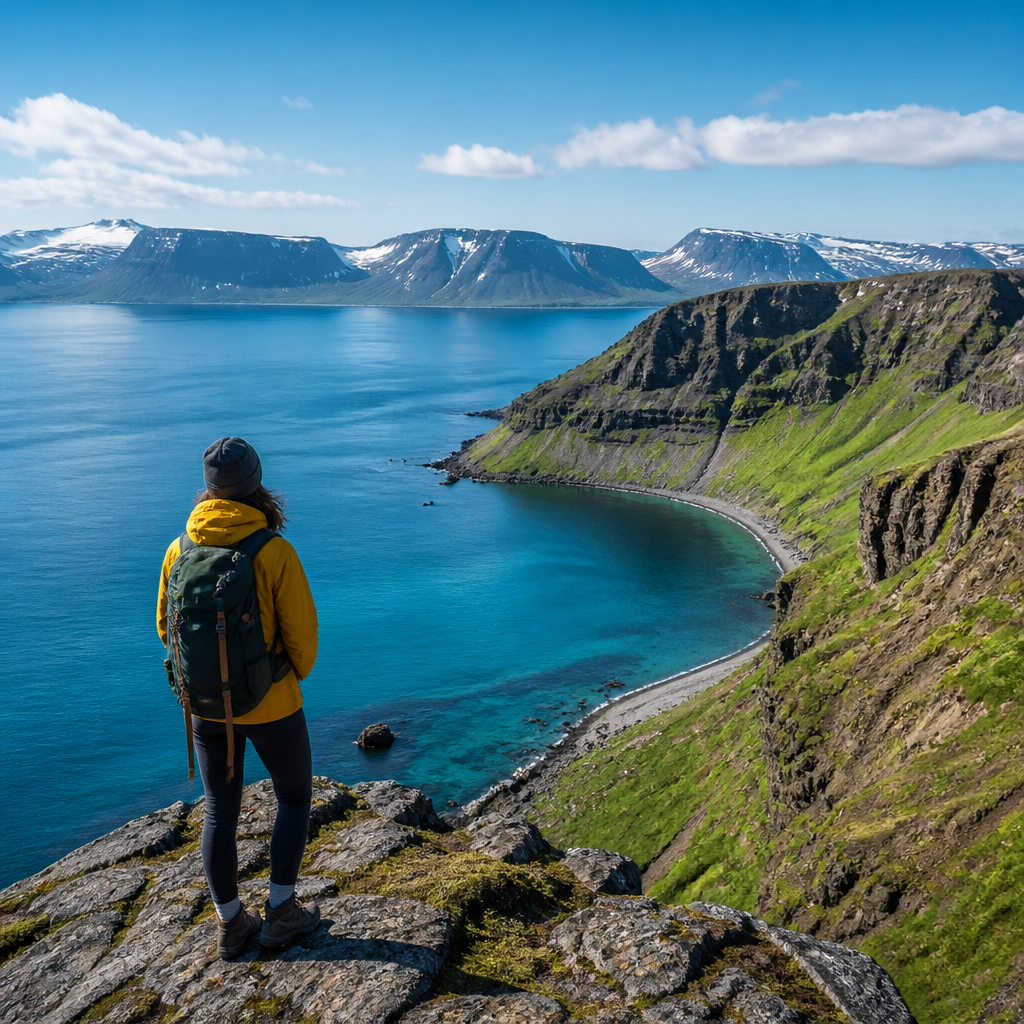
The asphalt gives way to gravel, and the world narrows. South of Hólmavík, Route 61 begins its relentless conversation with the coastline, a dialogue of switchbacks and sudden vistas that will define the next several hundred kilometers. This is the threshold of the Westfjords, the jagged peninsula that sprawls from Iceland’s northwestern corner like a colossal, arthritic hand reaching into the Greenland Sea. To come here is to consciously uncouple from the Iceland of tour buses and geothermal spas. It is an intentional act of seeking out the quiet, the remote, and the beautifully, unapologetically empty.
The Ring Road, for all its undeniable splendor, has become a loop of greatest hits. The Westfjords, by contrast, are the deep cuts. They demand more from the traveler—more time, more patience, more willingness to embrace the unpaved path. The reward is a landscape that feels less presented and more discovered, a corner of the world still governed by weather and tide, where the silence is so profound it feels like a physical presence.
The Geography of Isolation
The map of the Westfjords looks like an EKG reading of a racing heart. The fjords themselves, carved by Pleistocene glaciers, are immense, u-shaped valleys flooded by the sea. Driving their perimeter is a lesson in fractal geometry; for every kilometer you advance as the crow flies, you might drive ten along the water's edge. The roads cling to scree slopes, tracing the shoreline with a dogged loyalty that is both unnerving and magnificent. In one moment, you are at sea level, close enough to smell the salt and kelp. In the next, you are ascending a high pass, the fjord laid out below like a cartographer's dream, the water a sheet of hammered pewter under a low, dramatic sky.
This is a land shaped by departure. The ghosts of herring booms and fishing fortunes linger in the husks of abandoned farmsteads and rusting cannery equipment. Towns like Ísafjörður, the region’s largest settlement, feel like vibrant outposts of civilization huddled against the immense wilderness. But it is the space between the towns that defines the experience. It is a landscape that speaks of resilience, both of the people who have clung to this edge for centuries and of the land itself, which seems to shrug off human endeavor with an indifferent sigh. Here, history is not in a museum; it is written in the turf-roofed houses sinking back into the earth and the cairns that mark ancient walking paths over the mountains.
Encounters in the Emptiness
To be in the Westfjords is to recalibrate your senses to a subtler frequency. The grand dramas are there—the thundering cascade of the Dynjandi waterfall, a seven-tiered marvel that feels like a staircase for giants—but the lasting impressions are often smaller. They are found in the details that emerge from the stillness.
At Látrabjarg, Europe's westernmost point, the cliffs are a vertical city of seabirds. To lie on your stomach at the grassy edge, peering down at the swirling chaos of puffins, razorbills, and guillemots, is to witness a force of nature as potent as any volcano. The air is thick with their cries and the percussive beat of a million wings. It’s a riot of life on the precipice of a continent. Yet, just a few kilometers inland, you can enter the Hornstrandir Nature Reserve—an area with no permanent residents and no roads—and the world falls silent again. Here, your only companion might be an arctic fox, its white summer coat a startling counterpoint to the green tundra. Catching a glimpse is a gift, a brief and intimate encounter that underscores your status as a visitor in a world not your own.
These moments accumulate: the family of seals sunning themselves on a black rock in a deserted fjord; the otherworldly shimmer of the midnight sun on the water; the steam rising from a hidden geothermal pool, offering a primal warmth against the sharp, clean air. Life here is patient, persistent, and entirely on its own terms.
The Rhythm of the Road
One does not simply 'drive' the Westfjords. The journey is an active meditation, a forced slowing of pace. The roads, often winding ribbons of gravel, demand your full attention. You learn to read the texture of the surface, to anticipate the blind curves, to cede the right of way to wandering sheep who regard your vehicle with placid disinterest. This is not a commute; it is an immersion.
Each turn reveals a new composition of rock, water, and sky. The impulse to constantly stop is overwhelming. You pull over not for a designated viewpoint, but because a particular slant of light has set a distant peak aglow, or because the clouds have momentarily parted to reveal the ice cap of Drangajökull, the region's only glacier, shimmering on the northern horizon. You brew coffee on a camp stove by the side of the road and find it’s the best you’ve ever tasted. You eat dried fish and rye bread from a village bakery and it feels like a feast.
This slower rhythm seeps into you. The frantic need to 'get there' dissolves, replaced by a simple contentment with 'being here.' The road becomes the destination, a winding thread that connects not just places, but moments of quiet revelation.
The Internal Landscape
Ultimately, a journey through the Westfjords is as much an internal exploration as an external one. The vastness of the landscape has a way of quieting the noise within. The constant, low-grade hum of modern anxiety fades, replaced by the sound of the wind, the cry of a curlew, the crunch of your boots on a black sand beach. The scale of it all—the sheer cliffs, the endless sea, the sky that feels bigger than anywhere else—serves as a powerful corrective to the ego.
Out here, problems seem smaller, perspectives wider. Staring out at the Denmark Strait, with nothing but two thousand kilometers of cold ocean between you and Greenland, you feel a profound sense of solitude that is not loneliness. It is a state of being fully present, of feeling your own small, warm existence against the backdrop of an immense and ancient world. The emptiness outside creates a fullness within. This is the search that brings people to places like this: not just for beautiful scenery, but for a piece of themselves they can only find where the map has fewer lines.
You don't just leave the Westfjords; you carry a piece of its silence with you. It’s a resonant quiet that lingers long after you’ve returned to a world of notifications and deadlines—a reminder of a place where the land, the sea, and the sky still have the final say.