
The Granite Kingdom: In Search of Scale and Silence in the High Sierra
Beyond the reach of cell service and deadlines lies a world carved from granite and light. A journey into California's High Sierra is more than a trek; it's a pilgrimage to a quieter, grander version of ourselves, a recalibration of the soul against the immense scale of the wild.
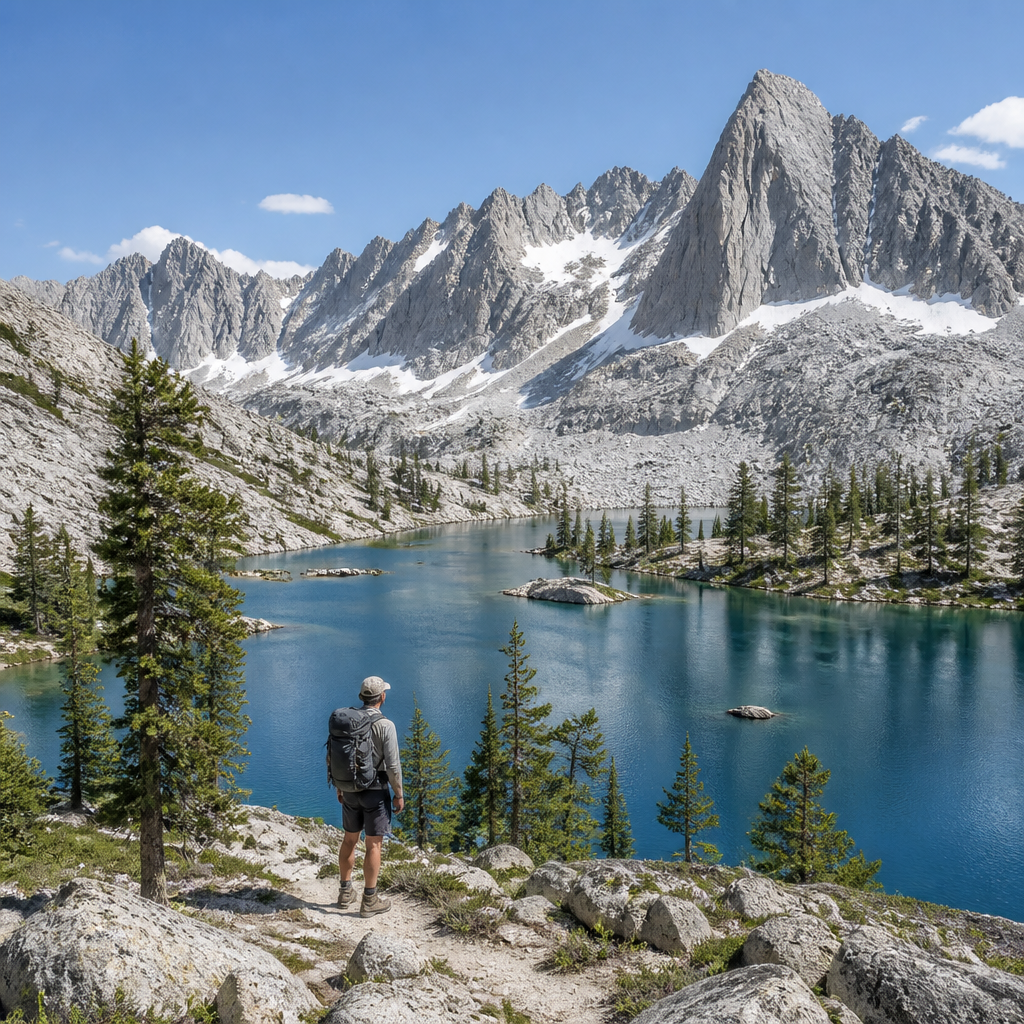
There is a low, ceaseless hum to modern life. It’s the whir of the server farm, the ghost vibration of a phone in a pocket, the endless tide of information breaking against the shores of our attention. We have grown so accustomed to the noise that we no longer hear it. To find true silence, you must walk away from it. You must walk until the only signals are the angle of the sun and the ache in your legs. You must walk into a place like the High Sierra.
To enter this kingdom is to consent to an elemental exchange. You trade convenience for presence, comfort for clarity. The Sierra Nevada, John Muir’s ‘Range of Light,’ is not a passive landscape to be observed from a scenic overlook. It is an active participant in your journey. It demands your breath as you climb its passes, mirrors your awe in its alpine lakes, and whittles away your anxieties with every mile of granite-dusted trail.
The Invitation of Altitude
There’s a reason this place has been a pilgrimage site for generations of seekers. The allure begins with the granite itself. Born of fire and sculpted by ice, the mountains have a stark, honest beauty. In the mornings, the rising sun sets the eastern faces ablaze in alpenglow, a fleeting spectacle of pink and orange on ancient stone. By midday, the light is sharp and unfiltered, carving deep shadows that accentuate the sheer scale of the landscape. Every jagged ridgeline and glacier-polished dome feels like a testament to forces far greater and older than ourselves.
Being here is an exercise in perspective. Standing at the base of a 13,000-foot peak, your meticulously planned itinerary and worldly concerns seem laughably small. The mountain does not care about your schedule. The marmot sunning itself on a warm rock is not impressed by your job title. This humbling is not demoralizing; it’s liberating. It’s the profound relief of realizing you are a small, temporary part of a very large, very old story. You are a guest in the house of gods, and the price of admission is your ego.
The Ritual of Preparation
A journey of this magnitude begins months before you take the first step. The modern-day rite of passage is not a test of strength, but of patience: the permit lottery. It’s a humbling digital scramble that underscores the preciousness of the wilderness we seek to enter. But this is just the first filter.
The real preparation is a meditative process. It’s the curation of a world on your back, an act of radical essentialism. Your pack, shelter, and sleep system—the backpacker’s ‘Big Three’—become your trusted companions. The choice is less about brands and more about a philosophy: how much warmth is non-negotiable? How much weight can you carry before joy turns to toil? Every item is weighed, considered, and justified. The food you pack is not for gastronomical delight, but for pure fuel. Dehydrated meals, dense energy bars, and fistfuls of trail mix become the currency of forward motion.
Laying everything out on the living room floor, you see a life stripped to its core: shelter, warmth, sustenance, a map. The 30-pound pack that feels so heavy at first is, in reality, the weight of freedom—freedom from the tyranny of too many choices and too many things.
The Cadence of the Trail
The first few days are a period of violent adjustment. Your body rebels, your lungs burn in the thin air, and your mind still churns with the residue of your other life. Then, somewhere around day three or four, a shift occurs. You fall into a rhythm that is as old as humanity itself.
Wake with the first light. The air is crystalline and cold. You boil water, the roar of your tiny stove the only man-made sound for miles. You walk. Your world shrinks to the next switchback, the next stream crossing, the next pass. The act of walking becomes a mantra. Left foot, right foot, breathe. Your thoughts, once a frantic, tangled mess, begin to unspool. The internal chatter quiets, replaced by an external awareness. You notice the subtle shift in flora as you gain elevation, the impossibly intricate patterns of lichen on a boulder, the piercing cry of a pika echoing across a talus field.
Cresting a pass like Forester—the highest point on the Pacific Crest Trail—is a moment of transcendence. After hours of relentless climbing, you stand on a thin saddle of rock, straddling two distinct worlds. Before you lies a new valley, a new set of peaks, a new promise. The view is a physical blow, a panorama so vast it feels less like you’re looking at a landscape and more like the landscape is looking into you. In that moment of breathless exhaustion and boundless beauty, you are purely, magnificently alive.
Returning with the Silence
The trail eventually descends, leading you back to a road, a car, a town. The re-entry into the civilized world is a jolt. The speed of cars feels reckless, the ambient noise of a cafe is a cacophony. Your phone, once a dead weight, comes back to life with a flood of notifications—a digital torrent from a world you had almost forgotten.
It’s tempting to feel that the journey is over, that the magic has been left behind at the trailhead. But the Sierra gives you a parting gift. You carry the silence with you. It becomes an internal anchor, a point of stillness you can return to in your mind. The memory of the granite peaks, of drinking water straight from its source, of the immense, star-filled sky—these things change your internal architecture.
You have learned the difference between the essential and the extraneous. You have recalibrated your own scale against that of a mountain. You came to the Granite Kingdom seeking an escape, but what you found was a more fundamental way of being. And in the quiet moments of your life back home, you will hear it: not the hum of the world, but the faint, resonant echo of the silence you earned.
<!-- seo-rank-booster:v1 -->Frequently Asked Questions
What is so special about the High Sierra?
The High Sierra, often called the "Range of Light," is renowned for its immense granite landscapes, thousands of alpine lakes, and profound sense of scale and solitude. A High Sierra backpacking trip offers a challenging yet transformative escape into a world sculpted by glaciers, providing a deep connection with true wilderness.
How do you prepare for a High Sierra backpacking trip?
Preparing for a trip involves physical conditioning for high altitude, securing a wilderness permit (often via a competitive lottery), and carefully selecting lightweight gear. Essential preparation includes planning your route, packing high-calorie food, and assembling a reliable kit for shelter, warmth, and navigation to ensure safety and enjoyment on the trail.
What is the best time of year to hike in the High Sierra?
The best time for High Sierra backpacking is typically from July through September. During these summer months, the snow has largely melted from high passes, weather is generally more stable, and creek crossings are safer. However, hikers should always be prepared for afternoon thunderstorms and cold nighttime temperatures even in summer.
What are the "Big Three" in backpacking gear?
The "Big Three" in backpacking refers to your shelter system (tent or tarp), sleep system (sleeping bag/quilt and pad), and your backpack. These items are the foundation of your kit and usually the heaviest. Choosing lightweight, effective options for the Big Three is crucial for a successful trip in demanding terrain like the High Sierra.
Related on Bucketlist Field Guide
- Hyperlite Mountain Gear Unbound 40 — Essential gear for a multi-day trek, this ultralight pack embodies the radical essentialism discussed in the article.
- Therm-a-Rest NeoAir XLite NXT — A key component of the 'Big Three,' this sleeping pad is a top choice for balancing weight and comfort on a High Sierra journey.
- Jetboil Stash Cooking System — The article mentions the "roar of your tiny stove," and this lightweight system is a perfect example of essential cooking gear for the backcountry.
- ZOLEO Satellite Communicator — For journeys "beyond the reach of cell service," a satellite communicator like this is a critical piece of safety equipment.
- The Ultralight Shelter Revolution: Trekking Pole Tents in 2026 — This guide dives deeper into the philosophy of choosing a shelter, a central theme of preparing for a wilderness pilgrimage.