
Haida Gwaii: The Echoes on the Edge
On the remote archipelago of Haida Gwaii, the line between myth and reality blurs. Here, ancient rainforests drip with moss, totem poles stand as silent sentinels, and the echoes of the Haida Nation resonate in the wind and waves. A journey to these 'Islands of the People' is a pilgrimage to the heart of the wild Pacific Northwest.
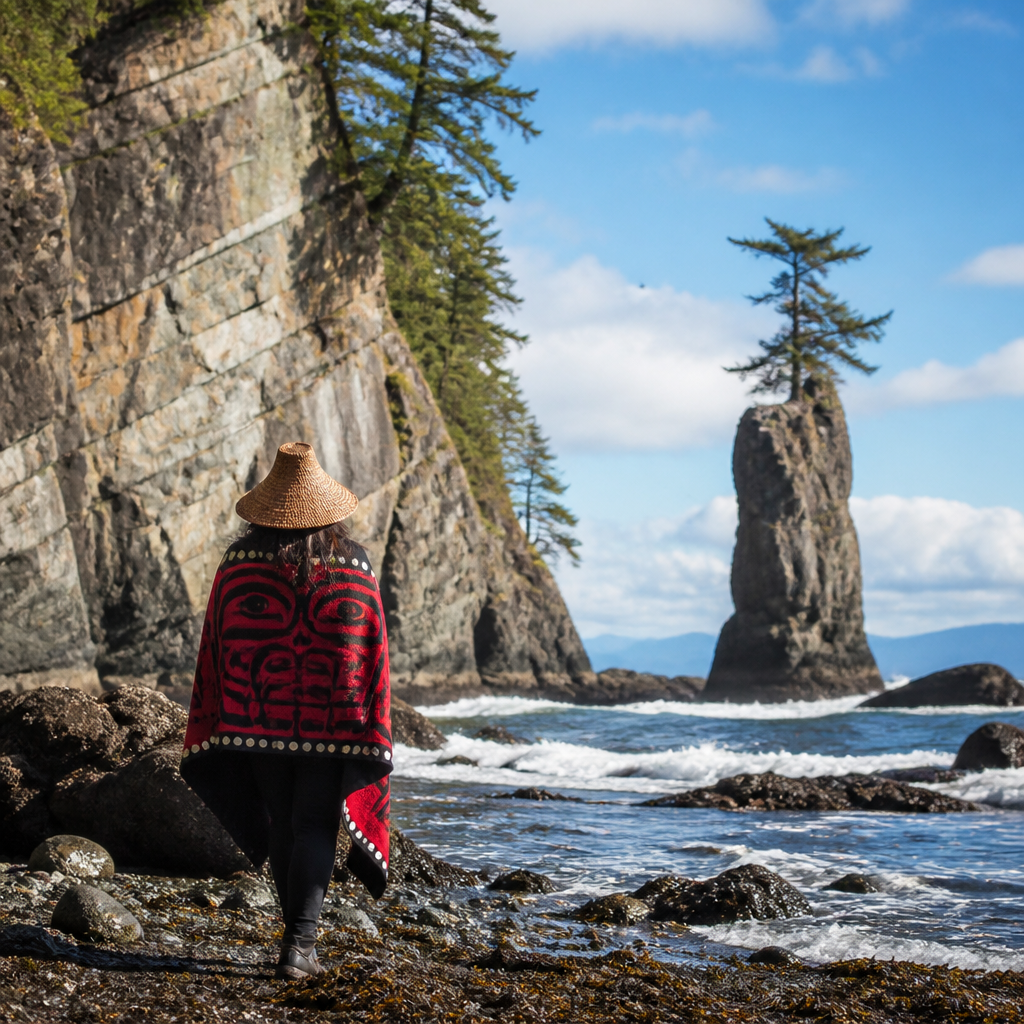
There are places on the map that feel less like destinations and more like shifts in consciousness. To get to Haida Gwaii, you must cross the Hecate Strait, a notoriously tempestuous body of water that separates this 150-island archipelago from the British Columbia mainland. Whether you arrive by the eight-hour ferry—a slow, deliberate severing of ties—or drop through the clouds onto the runway at Sandspit, the feeling is the same: you have crossed a threshold. The air is different here. It’s heavy with salt and the scent of cedar, thick with a mist that seems to hold stories. This is the edge of the world, and it has a voice, if you are quiet enough to hear it.
Formerly known as the Queen Charlotte Islands, the archipelago was officially renamed Haida Gwaii in 2010, a name that translates to 'Islands of the People.' The change was more than symbolic; it was an acknowledgment of an indivisible truth. This land cannot be understood apart from the Haida Nation, whose presence here is measured not in centuries, but in millennia. To visit is to be a guest in a very old home, one where myth, memory, and landscape are woven into a single, intricate fabric.
The Land of Mythic Proportions
To walk through the forests of Haida Gwaii is to step inside a living cathedral. This is the heart of the temperate rainforest, an ecosystem of staggering biomass and antiquity. Sitka spruce, western hemlock, and red cedar trees, some a thousand years old, pierce the sky. Their canopy is so dense that the forest floor exists in a perpetual twilight, a world of green-on-green. Everything is draped in moss—a thick, verdant velvet that muffles sound and softens every surface. The air is cool and damp, punctuated by the steady, meditative drip of moisture from leaf to fern to forest floor.
Life here has evolved in splendid isolation, resulting in a unique biological tapestry. The Haida Gwaii black bear, genetically distinct and larger than its mainland cousins, patrols the salmon streams with an unnerving confidence. The Pine marten is smaller, the shrew larger. Even the stoats are a different shade. The islands are a gallery of evolution’s subtle artistry. The coastline is a dramatic counterpoint to the forest’s quiet interior. Here, wild Pacific storms sculpt the shore, hurling massive driftwood logs onto crescent beaches and carving sea stacks from the unforgiving rock. The sea is a mercurial entity—placid and turquoise one moment, a raging grey chaos the next. It is the giver of all life, the source of sustenance, and the keeper of time.
Sentinels of the Past
History in Haida Gwaii is not confined to books; it is carved into cedar and washed by the tides. Nowhere is this more palpable than at SG̱ang Gwaay Llnagaay (Ninstints), a UNESCO World Heritage Site on a small island in the Gwaii Haanas National Park Reserve. To approach this ancient village site by boat is an experience that borders on the sacred. Out of the mist, they appear: a line of mortuary and memorial poles, weathered to a silver-grey, their carved faces softened by time and rain. They are not arranged for display; they stand where they were raised, facing the sea, bearing silent witness.
These are not merely sculptures. They are genealogical documents, deeds to the land, markers of profound events, and the final resting places of chiefs. To see them here, in situ, is to understand their true power. They are slowly, gracefully returning to the earth from which they came, a process the Haida embrace. In their worldview, everything is cyclical. The poles are not meant to be preserved in glass cases but to live and die with the forest. This acceptance of decay and transformation is a quiet, powerful lesson in a world obsessed with permanence.
Of course, one cannot speak of history here without acknowledging the devastation. European contact brought smallpox epidemics that reduced the Haida population from tens of thousands to fewer than 600 by the late 19th century. Yet, the story of SG̱ang Gwaay and other ancient village sites is not just one of loss, but of incredible resilience. Today, a profound cultural renaissance is underway, fueled by a new generation of artists, leaders, and knowledge-keepers. The carvers are carving again, the weavers are weaving, and the language is being spoken. The silent sentinels on the shore are no longer just relics of a lost past; they are touchstones for a vibrant, living future.
The Modern Pilgrimage
Visiting Haida Gwaii is not an act of consumption, but of participation. The modern journey here requires intention and respect. The archipelago is broadly divided into two main islands: the more populated Graham Island to the north, and the wilder, largely protected Moresby Island to the south. The southern third of the archipelago forms Gwaii Haanas, a protected area co-managed by the Haida Nation and the Government of Canada, from the mountaintops to the seabed. Access to this sacred place is limited, and most visitors explore its winding inlets and ancient sites via multi-day kayak trips or on small, guided expedition vessels.
During the summer months, Haida Watchmen live at the main village sites within Gwaii Haanas. These are not guides in the typical sense, but guardians and storytellers. They welcome visitors, share the stories of the poles and longhouses, and ensure that these sacred places are treated with the reverence they deserve. To sit with a Watchman, sharing a cup of tea while a raven—a key figure in Haida cosmology—observes from a nearby branch, is to experience a form of tourism that feels more like a genuine human connection.
Even outside the protected reserve, the islands invite a slower, more deliberate pace. You can wander the endless expanse of North Beach near Masset, where the wind howls and the surfing is surprisingly good. You can hike in Naikoon Provincial Park through bogs and forests to the wreckage of a WWII-era plane. You can spend a day at the Haida Heritage Centre at Kay Llnagaay, an architectural marvel whose soaring roofline evokes the traditional longhouses that once lined these shores.
In the end, a journey to Haida Gwaii is a journey inward. The archipelago demands a different kind of attention. It asks you to put away your phone, to listen to the silence between the raven’s calls, to feel the rhythm of the tides, and to understand your own small place in a story that is immeasurably old and profound. You leave not with a checklist of sights, but with a quiet resonance in your bones—the enduring, powerful echo of the Islands on the Edge of the World.